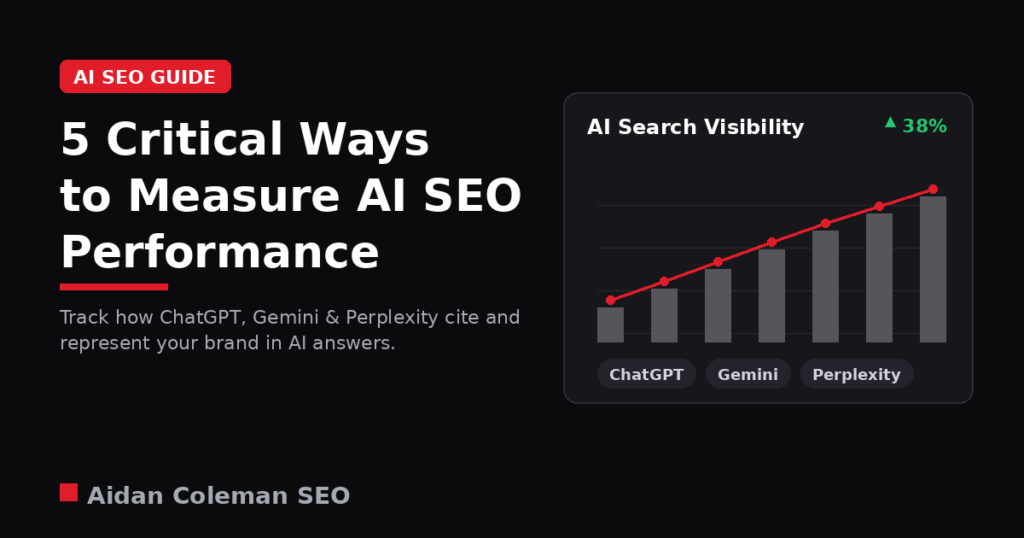
5 Critical Ways To Measure AI SEO Performance
 The search landscape has shifted dramatically in 2026. We are no longer just tracking blue links and keyword rankings; we are now optimising for how LLMs perceive and present our brands. Understanding how to measure AI SEO performance is essential for any business wanting to remain visible in AI-generated answers. It requires a blend of hard data and strategic oversight to ensure your content is actually reaching the right audience through these new discovery engines.
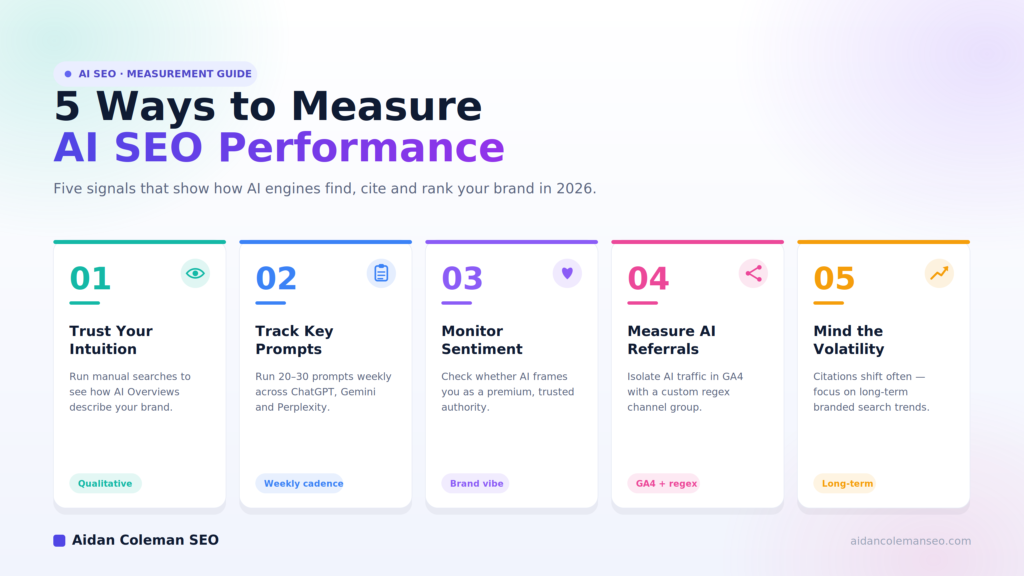
1. Trusting Your Professional Intuition
Data provides the foundation, but your expert intuition is what allows you to interpret the nuances of AI search. A qualitative audit remains one of the most effective ways to gauge your standing. Regularly perform manual searches for your primary topics to see if your brand triggers an AI Overview. When your business is mentioned, pay attention to the context. Is the AI effectively communicating your unique value? If the summary feels generic or misses the mark, it indicates a need for more intentional content strategy to sharpen your brand voice. Using your intuition helps identify gaps in authoritative signals that automated tools might overlook.
2. Setting Up Strategic Prompt Tracking
AI models are non-deterministic, meaning they can provide varying responses to identical queries. To get an accurate reading of your performance, you must track specific prompts over a period of time. Build a library of 20 to 30 strategic prompts that reflect the actual search intent of your target customers. By running these prompts through platforms like ChatGPT, Gemini and Perplexity once a week, you can identify patterns. You want to see if your site is consistently cited as a primary source or if the model recommends your services as a top-tier option.
3. Monitoring Your Brand Sentiment
In the world of AI search, visibility is only half the battle. You also need to understand the “vibe” or sentiment the model associates with your brand. AI models categorise businesses based on their perceived trustworthiness and expertise. Is the model describing you as a premium industry leader or a low-cost alternative? You can use specialised tools to analyse these AI responses and generate a sentiment score. This metric tells you if the model views your brand as a reliable authority. If the sentiment is neutral or skewed, you should focus on improving AI search visibility by strengthening your off-page signals and ensuring industry citations align with your desired brand identity.
4. Analysing AI Search Referral Traffic
While many users get their answers directly within the AI interface, high-intent researchers will still click through to your website for more depth. You can isolate this traffic within Google Analytics 4 (GA4) by setting up a custom channel group. Use a regex filter to capture traffic from known AI referrers like chatgpt.com, perplexity.ai and gemini.google.com. This allows you to track exactly how many sessions are being generated by AI assistants. These visitors often represent a more qualified lead because they have already been “pre-vetted” by the AI before landing on your page.
5. Understanding Current Measurement Limitations
It is important to remember that AI SEO is an evolving channel that fluctuates a lot. Because models are updated and retrained frequently, your citations might appear and disappear without much warning. This volatility is a natural part of a growing search medium. You should also be aware of “dark traffic”, where AI tools do not always pass through clear referrer data to your analytics. This means some of your direct traffic is likely coming from AI interactions that cannot be perfectly attributed. Rather than worrying about daily shifts, focus on long-term trends and overall growth in branded search volume to truly understand your impact.
Common Mistakes to Avoid When Measuring AI SEO Performance
1. Treating mentions like standard backlinks
It’s a mistake to think a citation is only about passing link equity or just for mere link building strategy. When it comes to AI a mention is actually about proving to the model that you are a trusted leader in your field.
2. Relying on a single snapshot of data
Because AI models are non-deterministic, they can give different answers at different times. If you don’t track your prompts over a week or a month, you’ll miss the trends that show how to measure AI SEO performance accurately.
3. Ignoring the impact of dark traffic
Many AI platforms don’t pass on referral information to your analytics. This means you might see a spike in direct traffic and fail to realise it’s actually coming from a recommendation in ChatGPT or Perplexity.
4. Focusing on rankings instead of context
In traditional search, position one is everything. With AI, being mentioned in a positive and helpful context is often more valuable than just being the first link in a list.
5. Underestimating the volatility of the channel
AI search is still a growing medium that fluctuates a lot. It’s a mistake to change your entire SEO strategy based on a few days of lower visibility when the models are constantly being updated.
Final Thoughts
Mastering how to measure AI SEO performance is a journey of adaptation rather than a one-time setup. As this is a growing channel that fluctuates a lot, success depends on your ability to look beyond traditional rankings and focus on how models interpret your brand authority. By staying curious and tracking the right signals, you can turn the uncertainty of generative search into a competitive advantage.