
TL;DR:
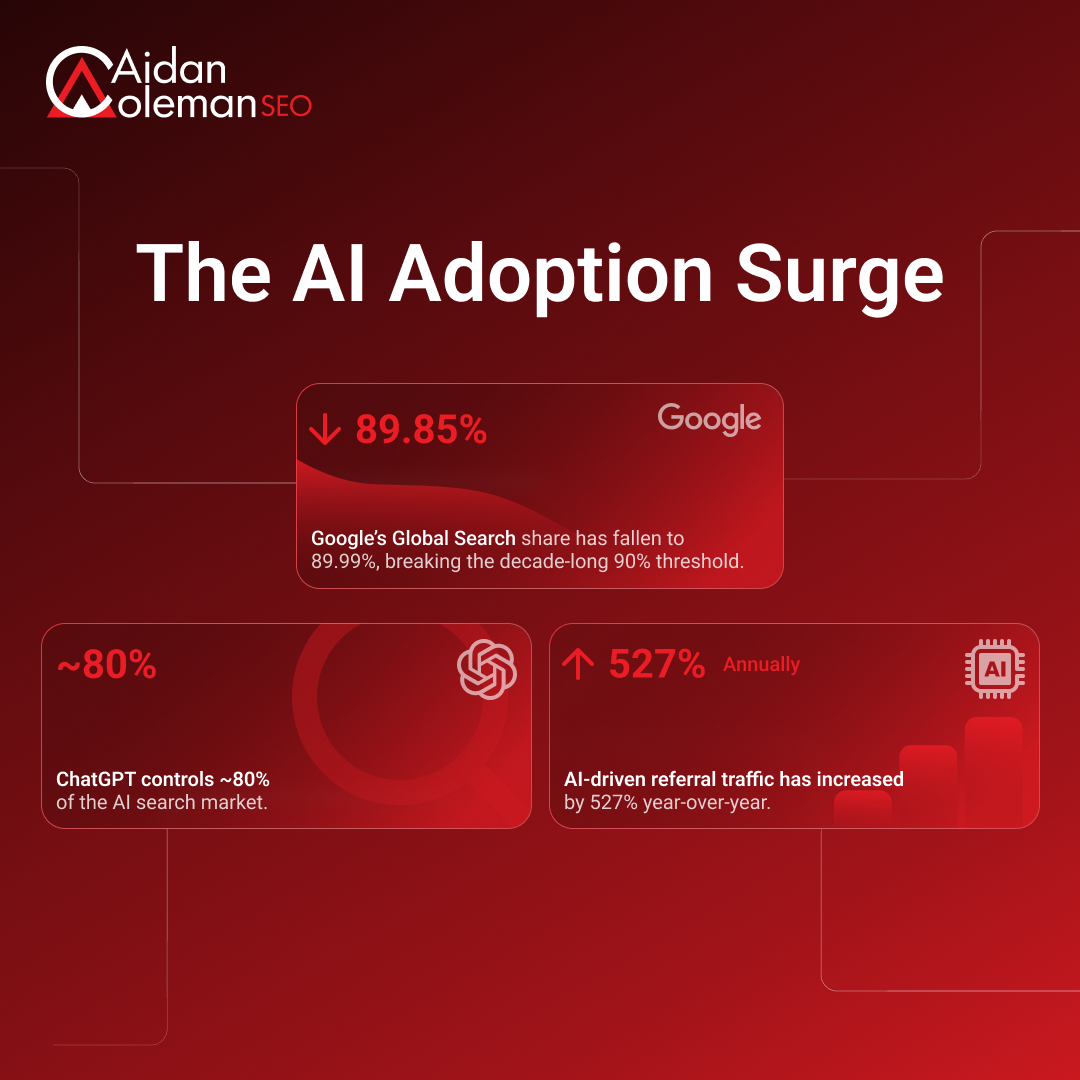
- Market shift. ChatGPT sends roughly 78% of all AI chatbot referrals to websites, while Google’s search share has slipped below 90% for the first time in a decade. Search is no longer one destination. It is fragmenting across conversational assistants.
- The zero-click reality. 68.01% of US Google searches now end without a click, up from 60.45% in 2024. Only 276 of every 1,000 searches reach the open web, down from 374. Visibility inside the answer is the new priority.
- Quality over volume. Clicks are scarcer but far more valuable. Semrush measured AI search visitors converting 4.4x better than traditional organic, and Adobe recorded AI-referred retail conversion flipping from 38% worse to 42% better in twelve months.
- What actually gets cited. Ranking still helps, but the link between ranking and citation is breaking. Ahrefs found the share of AI Overview citations coming from top-10 pages fell from 76% to 38% in eight months.
- Authority wins, and mentions now beat links. Across 75,000 brands, Ahrefs found branded web mentions correlate 0.664 with AI Overview visibility against 0.218 for backlinks. Roughly three times the signal.
Before looking at the AI SEO stats, it helps to grasp how much AI now shapes search results in 2026. I have kept this to the numbers that matter for your business, and every one of them links back to the original research rather than to somebody else’s roundup.
The bottom line: in 2026, success is less about ranking first and more about becoming the source the AI quotes. If your brand is not in the summary, you are invisible to a growing share of the market.
Artificial intelligence has changed SEO permanently. Between Google’s AI Overviews, the newer AI Mode, and conversational engines like ChatGPT and Perplexity, search is increasingly driven by systems that summarise, cite and recommend rather than simply list.
In many cases users get everything they need without clicking anything at all.
So how do you get discovered and chosen in that environment? There is no secret formula, same as traditional SEO. But there is data. Below are 75 AI SEO statistics showing why it matters, where the real risk sits, and how to position your business to capture visibility instead of losing it.
I have also included original research further down: my own measurement of how often AI platforms cite Australian websites, across more than two million citations.
A note on sourcing. Every statistic names its source, its sample size and its date. Where a number comes from a small sample, a single company’s own traffic, or a vendor with something to sell, I say so in the line rather than hiding it. Where something is a forecast rather than a measurement, I say that too.
AI Search Adoption
- ChatGPT passed 900 million weekly active users and 50 million paying subscribers. OpenAI announced the figure in February 2026, more than double the 400 million it reported a year earlier. This level of reach makes ChatGPT a primary place your customers look for answers before they ever visit a website.
- ChatGPT handles roughly 2.5 billion prompts a day. OpenAI gave that figure to Axios in July 2025, with about 330 million coming from US users. Two years earlier the number was closer to one billion a day.
- AI referral traffic grew 527% year on year. Previsible reported the jump in August 2025, comparing the first five months of 2024 with the same period in 2025. That kind of acceleration is the hallmark of an interface shift rather than gradual adoption.
- AI referral traffic to US retail sites has grown 1,219% since October 2024. Adobe has been tracking this across more than a trillion retail visits, and the climb has been steady rather than one big spike.
- OpenAI serves more than 7 million ChatGPT workplace seats, with enterprise seats up roughly 9x year on year according to the company. AI use has moved past pilot projects into real workflows at scale.
- Google’s AI Mode passed 75 million daily active users. Google reported the milestone during 2025. AI Mode removes traditional results entirely, so citation is the only route to visibility there.
- The Gemini app reached roughly 750 million monthly users, growing almost 90% in under a year on Google’s own numbers. It is built into Android, so it matters disproportionately for mobile.
- Meta AI reports around 4 billion monthly active users across WhatsApp, Instagram and Facebook. Social platforms are now AI-powered answer engines, though “monthly active” measured across an integrated suite is a generous definition and the figure is Meta’s own.
- Two in three people now use AI tools regularly. The University of Melbourne and KPMG put the question to 48,340 people across 47 countries over the summer of 2024-25, and 66% said they use AI deliberately for work, study or everyday life.
- Google Search revenue still grew 19% year on year, to $60.4 billion in Q1 2026. Sundar Pichai credited AI features on the earnings call, saying the company is seeing incremental total query growth thanks to AI Mode. It is a self-interested claim, but whatever else is happening, search is not collapsing.
- Gartner predicted search volume would drop 25% by 2026, and it did not happen. The forecast went out in February 2024, and Google has since held roughly 90% market share and grown revenue. It still gets quoted as though it already happened.
- AI referral traffic is still only about 1.08% of total sessions. Conductor worked that out across 13,770 domains and 3.3 billion sessions, with ChatGPT responsible for 87.4% of it. Keep this number in your head while reading the rest. AI search is growing fast from a very small base.
AI Overview Statistics
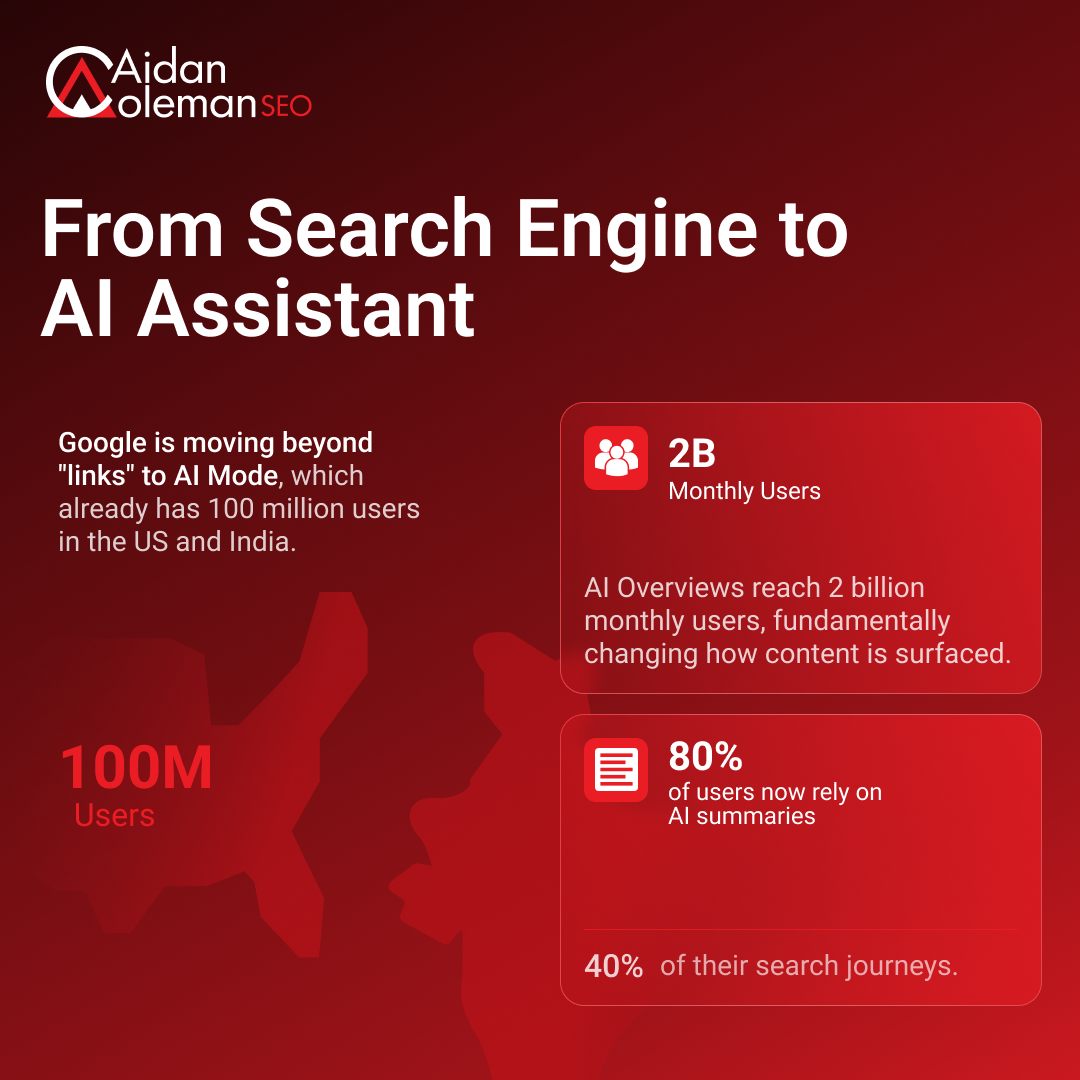
- AI Overviews reach around 2 billion users a month across more than 200 countries, on Google’s own reporting. This is no longer a test inside Search.
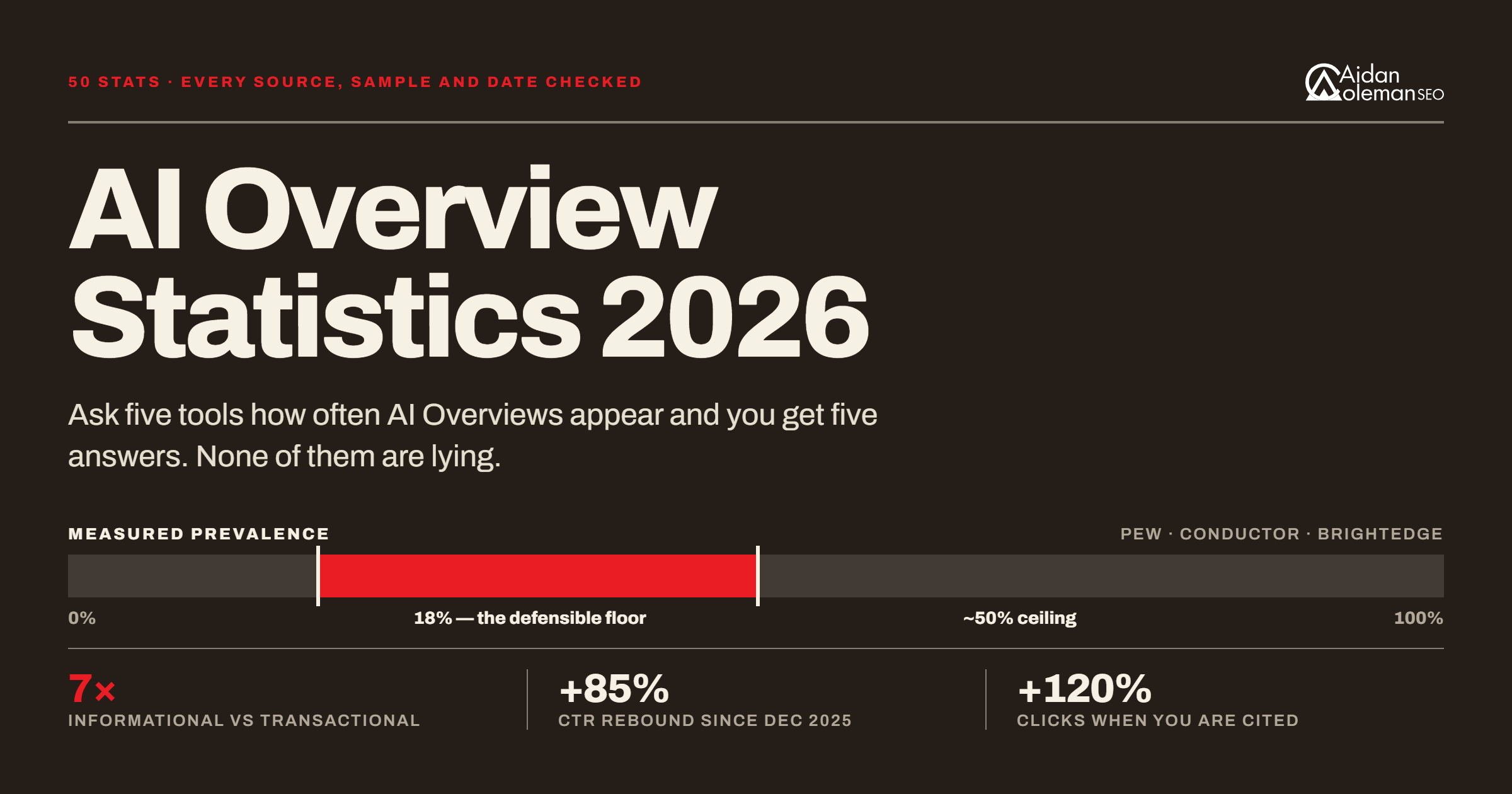
- AI Overviews appeared on 25.11% of Google searches in Q1 2026. That comes from an analysis of 21.9 million Google searches, up from 13.14% in March 2025.
- Semrush saw prevalence peak at about 24.6% in July 2025, then fall to 15.69% by November after Google recalibrated, across a sample of more than 10 million terms.
- BrightEdge put the figure closer to 48% of tracked queries in early 2026, a 58% year-on-year rise. Their keyword set skews commercial, which is exactly why their number runs higher than everyone else’s.
- The honest answer is a range of 20% to 50%. Anyone quoting a single figure as the truth is quoting their own keyword set. Your real exposure depends on your industry, not the average.
- Coverage by industry runs from 88% down to single digits. BrightEdge tracked Healthcare at 88%, Education at 83%, B2B Technology at 82%, Restaurants at 78% and Insurance around 63% between February 2025 and February 2026. Education jumped from 18%, a 361% rise in a year.
- E-commerce went the other way, falling from roughly 29% to 4% over the same period, as Google pulled AI Overviews back from transactional queries.
- About 18% of Google searches produced an AI summary, and 88% of those cited three or more sources. Pew followed 68,879 searches from 900 US adults to find that. The typical summary ran 67 words.
- Only 38% of AI Overview citations now come from pages ranking in the top 10, down from 76% in July 2025. Ahrefs measured the collapse across 863,000 keywords and 4 million AI Overview URLs in March 2026. This is the most important correction in this article, because the old “76% comes from page one” figure is still quoted everywhere and it is a year out of date.
- 67.82% of pages cited in AI Overviews do not rank in Google’s top 10 for the query or its fan-out variations, according to Surfer’s analysis of 10,000 keywords in November 2025.
- Moz ran 40,000 queries through Google AI Mode and found 88% of citations came from pages outside the organic top 10. A second dataset pointing the same way.
- Position-one pages are still cited 3.5 times more often than pages outside the top 20. That comes from picking apart 548,534 retrieved pages across 15,000 prompts. Ranking has not stopped mattering. It has stopped being sufficient.
- ChatGPT cites only 15% of the pages it retrieves. The other 85% get read, weighed up and thrown away before you ever see them.
- 89.6% of prompts trigger two or more fan-out queries, and 32.9% of cited pages are found only through those fan-outs. Stranger still, 95% of those fan-out queries had no measurable search volume at all, so they sit outside every keyword tool you own. You can be cited for a question you never targeted.
- Roughly 44% of LLM citations come from the first 30% of a page, across several 2025 and 2026 analyses. Front-loading your answer matters more than burying it after the preamble.
- AI Overview content changes around 70% of the time for the same query. Ahrefs found roughly 45.5% of citations get replaced when the answer regenerates, which makes AI visibility far less stable than rankings.
- About half of AI Overviews contain at least one unsupported claim, on Oumi’s analysis using its HallOumi detection model in late 2025 and early 2026. Hallucination rates vary hugely by model and query type, so treat the figure as indicative. For a local business it is not abstract though: a wrong phone number, stale opening hours or an outdated price can cost you the job without you ever seeing it happen.
AI Search Shifts
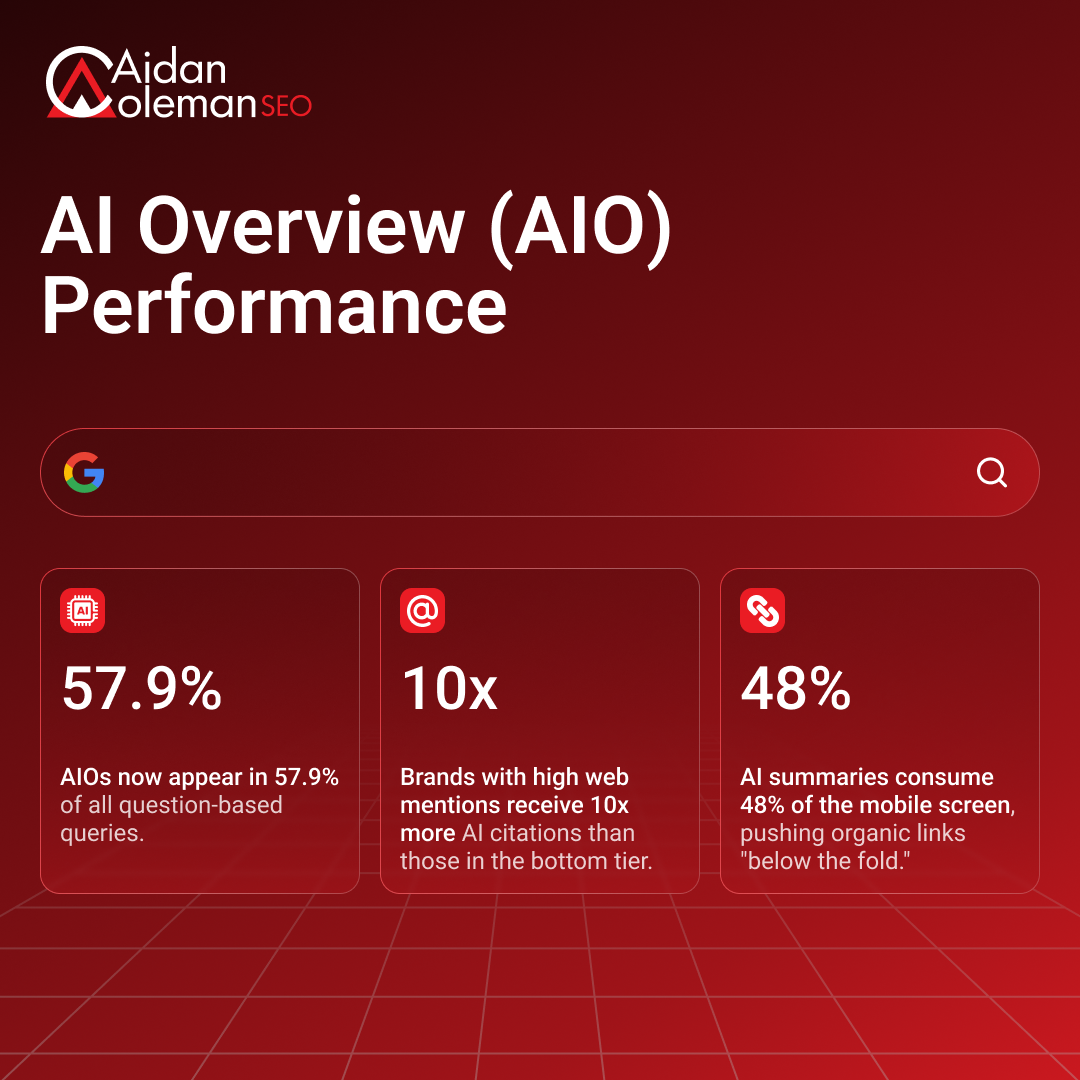
- 68.01% of US Google searches ended without a click in early 2026. Working from Similarweb’s clickstream panel, SparkToro found only 276 of every 1,000 searches now reach the open web, down from 374 two years earlier. The figure was 60.45% in 2024.
- Google AI Mode produces a 93% zero-click rate, on one analysis from September 2025. That is a single vendor’s data, but the direction is hardly surprising when AI Mode replaces the results page entirely.
- Position-one click-through rate fell 34.5% when an AI Overview appeared. Ahrefs checked it against 300,000 keywords in April 2025, using real Search Console data rather than estimates.
- Ahrefs re-ran the same study on December 2025 data and the drop had worsened to 58%, comparing click-through rates before AI Overviews existed with those at the end of 2025.
- Organic click-through rate on AI Overview queries fell 61%, from 1.76% to 0.61%. Seer followed 3,119 queries across 42 organisations and 25.1 million impressions to get there. Paid click-through rate fell even further, down 68%.
- Brands cited inside the AI Overview earned 35% more organic clicks and 91% more paid clicks than those left out, in the same Seer dataset. Being the source is worth real traffic.
- In early 2026 the decline reversed, with organic CTR rebounding 85%. The April 2026 update covered 53 brands, 5.47 million queries and 2.43 billion impressions, and found click-through rate climbing off a 1.3% floor in December 2025 to 2.4% by February. This is the most current data available and almost nobody is quoting it.
- Being cited now delivers 120% more organic clicks per impression than not being cited, but still 38% fewer than having no AI Overview at all. Seer’s per-million breakdown is the clearest way to see it: about 33,500 clicks with no AI Overview, 20,743 if you are cited, 9,445 if an AI Overview appears and you are not.
- Users clicked a traditional result in just 8% of searches with an AI summary, against 15% without. This one came from watching what people actually did rather than reading aggregate Search Console data, which makes it the most grounded number in this section. Google publicly disputed the methodology.
- Only 1% of users clicked a link inside the AI Overview itself. Pew also found people were more likely to end their browsing session entirely after seeing a summary, 26% against 16%.
- Amsive found a much milder average decline of 15.49%, across 700,000 keywords, and branded queries actually gained 18.68% click-through rate. When an AI Overview stacks on top of a featured snippet, though, the drop reached 37.04%.
- In German results, position-one CTR fell from 27% to 11%, a 59% collapse, on SISTRIX’s analysis of more than 100 million keywords.
Why these studies disagree so violently
The range runs from Amsive’s 15.49% to Ahrefs’ 58%, which looks like chaos until you check what each one measured.
Ahrefs isolated informational queries, where AI Overviews appear on more than 99% of results. Amsive averaged across all query types including branded and commercial ones, where AI Overviews are rarer and sometimes helpful. Pew measured real human behaviour rather than aggregate Search Console data. Seer tracked one cohort over time, which is why it caught a rebound everyone else missed.
They are not contradicting each other. They are answering different questions. The direction is unanimous.
- AI search visitors convert at 4.4 times the rate of traditional organic visitors. Semrush went through more than 500 high-value topics and published on 21 July 2025, a date half the internet gets wrong by a month.
- Ahrefs found AI visitors made up 0.5% of its traffic but drove 12.1% of signups, a 23x conversion multiplier. Their own analytics also showed those visitors spending 86 seconds on site against 78 for search visitors, while viewing fewer pages and bouncing slightly more. It is one SaaS company’s own traffic, so read it as directional, but they published the working. The behaviour makes sense: AI visitors arrive having done the research, check one thing, then act or leave.
- AI-referred retail conversion flipped from 38% worse to 42% better in twelve months. Adobe caught the swing across more than a trillion US retail visits between March 2025 and March 2026. By July 2026 the gap had widened to 60% better, an eleventh consecutive month of AI traffic outperforming.
- AI-referred retail traffic grew 393% year on year in Q1 2026, peaking at 1,151% in December during the holiday season. Adobe found those visitors generated 37% more revenue per visit and spent 48% longer on site.
- A counter-finding worth knowing: Amsive’s paired analysis across 54 sites found LLM traffic did not convert significantly differently from organic overall, with a p-value of 0.794. B2B showed a modest edge at 2.17% against 1.16%. This is the strongest challenge to the conversion-premium narrative, and both it and the 4.4x figure are real. Use them together.
- Nearly 90% of ChatGPT citations come from pages ranking at position 21 or below for the related query, in the same piece of research. It also found 50% of links in ChatGPT responses point to business and service websites rather than publishers.
- Branded web mentions correlate 0.664 with AI Overview visibility, against 0.218 for backlinks. Ahrefs ran the correlations across 75,000 brands and found brand anchors at 0.527, branded search volume at 0.392 and content volume at just 0.194. Around 26% of the brands studied had no mentions at all.
- YouTube mentions were the single strongest signal of all, at roughly 0.737. Ahrefs’ December 2025 follow-up extended the analysis to ChatGPT and AI Mode and the pattern held. Correlation is not causation here, since brands that earn mentions also tend to be brands that invest in everything else. But it is why link building now has to be thought about as brand building rather than link counting.
- Ahrefs found 67.8% of all non-cited URLs came from Reddit. Across 1.4 million prompts, ChatGPT read Reddit constantly for context but only cited it about 1.93% of the time.
- Only 16% of brands systematically track AI search performance. McKinsey surveyed around 30 Fortune 500 CMOs in September 2025 to get that, which is a small sample. GoodFirms separately found only 14% of marketers use AI citation tracking, despite 43% calling AI search optimisation a core 2026 strategy.
AI Search Engine Market Share Statistics for 2026
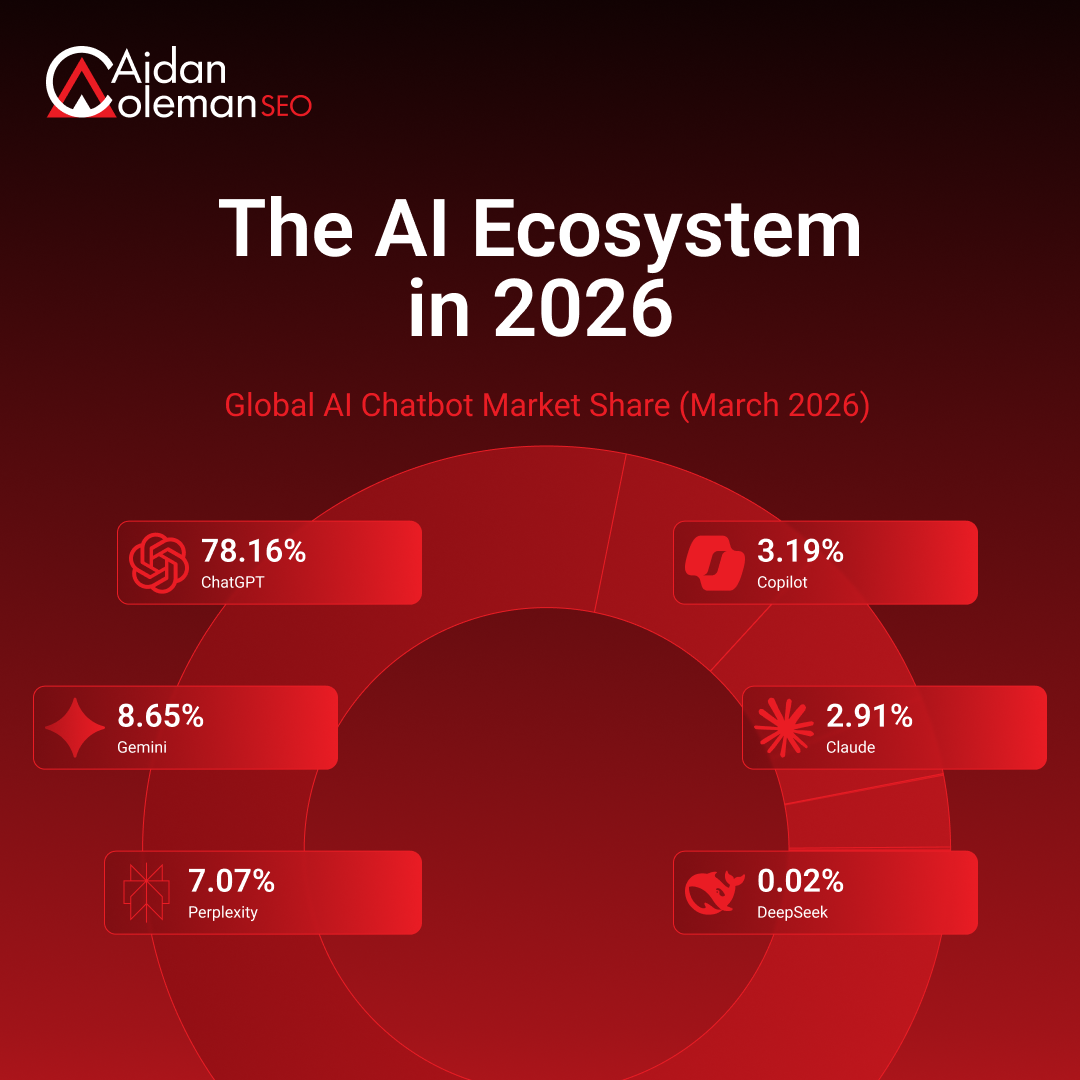
The figures below come from StatCounter, which tracks which chatbots actually send visits to websites, based on more than 3.8 billion monthly page views across 1.5 million sites.
One important clarification, because this gets misreported constantly. StatCounter measures referral share, meaning which chatbot sent the visit. It is not a measure of how many people use each tool. Grok is excluded entirely because it does not pass referral data in its header.
- ChatGPT: roughly 78% of AI chatbot referrals. Despite a growing field of rivals, OpenAI’s flagship remains the gatekeeper of generative search. Holding over three-quarters of referrals, it is where the vast majority of AI-driven brand discovery happens. A ChatGPT citation is not a bonus metric. It is the core one.
- Google Gemini: around 8.7%. Gemini’s strength is native integration across Android, Workspace and Chrome, which makes it the fastest-growing threat to ChatGPT and the bridge between traditional Google Search and conversational AI.
- Perplexity: around 7.1%. Built entirely around citations and real-time indexing, Perplexity is the most link-friendly AI tool, and its users are historically more likely to click through to sources. Data-backed content performs disproportionately well here.
- Microsoft Copilot: around 3.2%. Modest share, but its users sit inside Microsoft 365 all day. That makes it a critical platform for B2B providers reaching decision makers during the working day.
- Claude: around 2.9%. Anthropic’s model is used heavily for long-form analysis and technical work. For expertise-heavy sectors like legal, medical and complex technical services, a Claude citation is a strong trust signal.
- DeepSeek: around 0.02% globally, but 89.3% in China. Tiny in most markets, dominant in one, as was clear when the dataset first launched. Worth watching if you have any Asian market exposure.
- Google’s search share has slipped below 90% for the first time in a decade. In Australia it sat at 87.58% in August 2026, with Bing on 9.41% and Yahoo on 1.59%.
- A caution on all market share figures. StatCounter’s referral share is one measure. Similarweb’s analysis of generative AI web traffic put ChatGPT’s share at roughly 56.7% by March 2026, down from 86.7% in January 2025. Both are real. They count different things, and neither is “the” market share.
Our Own Data: Who AI Actually Cites in Australia
Everything above is published research. This section is mine.
I measured how often AI platforms cite Australian websites, pulling citation counts across ChatGPT, Google AI Overviews, Google AI Mode, Gemini, Perplexity and Copilot, filtered to Australian responses. 2,126,859 citations across 1,288,802 cited pages.
| Domain | AI citations | Cited pages |
| reddit.com | 1,938,398 | 1,198,179 |
| productreview.com.au | 91,447 | 34,175 |
| business.gov.au | 34,566 | 29,268 |
| realestate.com.au | 30,143 | 17,780 |
| hipages.com.au | 19,396 | 2,727 |
| yellowpages.com.au | 8,450 | 4,024 |
| healthengine.com.au | 2,586 | 1,960 |
| serviceseeking.com.au | 1,136 | 332 |
| oneflare.com.au | 737 | 357 |
- Reddit was cited 1,938,398 times in Australian AI responses, against 188,461 for all eight Australian domains combined. A US forum out-cites every major Australian directory by 10.3 to 1.
- ProductReview.com.au is the most-cited Australian domain at 91,447 citations, ahead of business.gov.au and realestate.com.au. Review platforms, not directories, are Australia’s AI citation engine, which makes your review profile an AI visibility asset rather than just a conversion one.
- Two competitors in the same category sit 26x apart. hipages earned 19,396 citations. Oneflare earned 737. Being in the right category does not make you a source.
- Depth beats breadth. hipages earns 7.1 citations per cited page against business.gov.au’s 1.2. A small number of genuinely useful pages gets quoted over and over.
- The platform that cites you depends on what kind of site you are. Oneflare draws 58.4% of its citations from Perplexity. business.gov.au draws 71.4% from ChatGPT. Reddit, the most-cited domain of all, draws just 5% from ChatGPT.
| Domain | ChatGPT | AI Overviews | AI Mode | Gemini | Perplexity | Copilot |
| reddit.com | 5.0% | 37.7% | 17.2% | 8.8% | 31.2% | 0.2% |
| business.gov.au | 71.4% | 6.5% | 4.0% | 2.7% | 9.8% | 5.5% |
| oneflare.com.au | 28.7% | 8.6% | 1.5% | 2.1% | 58.4% | 0.7% |
| yellowpages.com.au | 22.5% | 16.8% | 5.4% | 6.5% | 36.6% | 12.2% |
| productreview.com.au | 28.2% | 15.9% | 6.2% | 10.9% | 25.8% | 13.0% |
| hipages.com.au | 22.1% | 27.3% | 19.3% | 8.8% | 15.8% | 6.7% |
| realestate.com.au | 29.2% | 26.6% | 17.5% | 8.7% | 11.6% | 6.4% |
| healthengine.com.au | 23.3% | 23.7% | 12.3% | 15.0% | 20.2% | 5.6% |
| serviceseeking.com.au | 22.5% | 15.5% | 13.5% | 7.3% | 14.8% | 26.3% |
- Across the eight Australian domains, ChatGPT accounted for 33.9% of citations, then Perplexity at 21.0%, AI Overviews at 17.1%, Copilot at 10.3%, Gemini at 8.9% and AI Mode at 8.8%. Note how far that sits from StatCounter’s 78% referral share. Referrals and citations are not the same thing, and if you only check ChatGPT you are auditing a third of the picture.
Australian AI Search Statistics
Nearly every AI SEO statistics article you will read is US data. Here is what we actually know about Australia.
- 13.6 million Australians, or 58% of those aged 14 and over, used AI tools in an average four-week period. Roy Morgan asked 14,646 people between January and March 2026. ChatGPT led with 10.5 million users, Gemini 5 million and Copilot 4 million.
- 49% of Australians used generative AI in the previous year, up from 38% in 2023, in a Google and Ipsos survey of around 1,000 Australians conducted in late 2024.
- Australian SME AI adoption reached 44% in February 2026. The National AI Centre tracks this every month with at least 400 businesses per wave, and has it up from roughly 37% a year earlier.
- Around 12% of Australian businesses used AI in 2024-25, up from 1% in 2021-22. The Bureau of Statistics asked nearly 7,000 businesses and released the numbers in June 2026. The gap with the 44% above exists because the two measure different populations and thresholds, not because one is wrong.
- AI Overviews launched in Australia on 31 October 2024, announced quietly on Google’s Australian blog, with AI Mode following a year later in October 2025.
- Only 36% of Australians are willing to trust AI systems, against a global average of 46%. That same global study found 46% of Australians believe the risks outweigh the benefits, just 24% feel able to use AI tools effectively, and 77% say regulation is needed.
- Nobody has publicly measured how often AI Overviews appear in Australian search results. Every prevalence figure you will see quoted is a US sample. If someone tells you “X% of Australian searches show AI Overviews,” ask them for the source.
Australians use AI heavily and trust it less than almost anyone. That combination matters, because most people are still checking your website, your reviews and your Google listing after the AI names you.
AI search and local businesses
- Informational “near me” queries showed an AI Overview 76.9% of the time, across 188,606 impressions measured in April 2026.
- But transactional queries showed AI Overviews only around 5% of the time, and commercial queries around 8%. The half of local search where people actually book is still relatively protected.
- Google Business Profile signals account for roughly 32% of local pack influence, and review signals about 20%, up from 16% in 2023. Whitespark’s Local Search Ranking Factors survey of around 47 local SEO experts is expert opinion rather than controlled testing, so treat it as an informed estimate rather than measurement.
Put those three together and your local SEO and Google Business Profile are doing double duty: winning the searches AI has not taken, and feeding the answers where it has.
What Metrics Measure Success in AI Search Engines?
Rankings and sessions do not capture AI performance, because most AI influence never produces a click. Five metrics do.
Citation count, tracked per platform. How often AI platforms reference your domain and across how many unique pages. This is the closest thing AI search has to a ranking. Split it by platform rather than blending it, for the reasons in stat 64.
Share of voice against competitors. Your citations as a proportion of your category’s total. Absolute numbers mislead. Oneflare’s 737 sounds fine until you learn hipages has 19,396.
Prompt coverage. The percentage of the questions your customers actually ask where your business appears in the answer. More useful than raw counts because it is tied to real buying questions, and given that 95% of fan-out queries have no search volume, keyword tools will not find these for you.
AI referral traffic and its conversion rate, tracked separately. Most GA4 setups bury ChatGPT and Perplexity referrals in “Other” or misattribute them as direct. Given the conversion premium, your highest-intent traffic may be invisible in your own reporting. More on how to measure AI SEO performance.
Sentiment and factual accuracy. With roughly half of AI Overviews containing an unsupported claim, checking what the machine actually says about you is now part of the job.
What does not count: a screenshot of ChatGPT naming your business once. With citations changing around 70% of the time on regeneration, one good result is an anecdote. Same reason rank tracking alone was never enough.
Four AI SEO Statistics You Should Stop Repeating
This section exists because I got tired of tracing numbers back to nothing.
“76% of AI Overview citations come from top-10 pages.” True in July 2025. By March 2026 Ahrefs measured it at 38%, and Moz found 88% of AI Mode citations came from outside the top 10. If you are still quoting 76%, you are describing a search engine that no longer exists.
“Search volume dropped 25% in 2026.” A Gartner forecast from February 2024 that predicted a drop by 2026. Google grew search revenue 19% instead. Quote it as a prediction that missed.
“ChatGPT has 78% of AI search usage.” StatCounter measures referral share, not usage. It counts which chatbot sent a visit to a website, and it excludes Grok entirely. Similarweb’s traffic-based measure puts ChatGPT closer to 57%.
“AI Overviews cut clicks by 58% and it keeps getting worse.” Ahrefs did measure 58%, but Seer’s April 2026 data shows CTR rebounding 85% off its December 2025 floor. The collapse narrative is a year out of date.
From Statistics to Strategy
Here is where I tell most business owners to start.
Keep your content fresh and easy to parse, so engines can lift clean sections into their answers. Front-load the answer, since around 44% of citations come from the first third of a page.
Use the formats AI prefers. Structured, clearly segmented content gets extracted more readily. Lists, tables and direct question-and-answer blocks all help a model find a quotable unit.
Make your expertise visible with expert quotes, original data and clear proof points. Original statistics are among the most citable things you can publish, which is precisely why this article contains my own.
Build mentions, not just links. A 0.664 correlation against 0.218 is not a subtle difference, and YouTube mentions at 0.737 were stronger still. Being talked about now matters more than being linked to.
Be present in your community and online conversations. Reddit out-cites every Australian directory 10 to 1 in my data, and ProductReview out-cites every listing site. Community presence and review platforms feed directly into what AI tells people about you.
Check more than ChatGPT. It was 33.9% of citations across the Australian domains I measured, and under 6% for one of them.
Keep it in proportion. At 1.08% of sessions, AI is not yet a channel you can build a business on. It is one you make sure you are present in before it matters. Traditional SEO still pays the bills, and the AI layer sits on top of the fundamentals rather than replacing them.
At the end of the day this is not about chasing algorithms. It is about showing up where your customers are looking, and more of them are looking at AI every month. Take small, practical steps today and you will be in the right place tomorrow while your competitors are still catching up.
Methodology
My own citation data was pulled from Ahrefs in August 2026, using its AI response citation data filtered to Australian responses, across ChatGPT, Google AI Overviews, Google AI Mode, Gemini, Perplexity and Copilot. Nine domains were measured at subdomain scope, totalling 2,126,859 citations across 1,288,802 cited pages. Platform percentages are each domain’s share across those six platforms and exclude Grok, which Ahrefs reports separately. These are citation counts, not traffic: a citation means a platform used the page as a source, not that anyone clicked. Domain selection was judgement-based and is not a census.
Third-party statistics name their source, sample size and date in the line, and link to the original research wherever a verified URL exists. Where a commonly-repeated figure could not be traced to a primary source, it is flagged as unmeasured rather than repeated.
Every figure here is a snapshot of a field that moves monthly. This page is updated as the major studies refresh.
If you cite or reproduce this data, please link back to this page.