A strong page can still struggle to rank when the rest of the web gives search engines little reason to trust it. Backlinks help close that gap, but only when they come from credible pages and make sense for the reader.
This guide explains what a backlink is, how it works, what separates a useful link from a poor one and how to assess backlinks without being distracted by raw link counts.
What Is a Backlink?
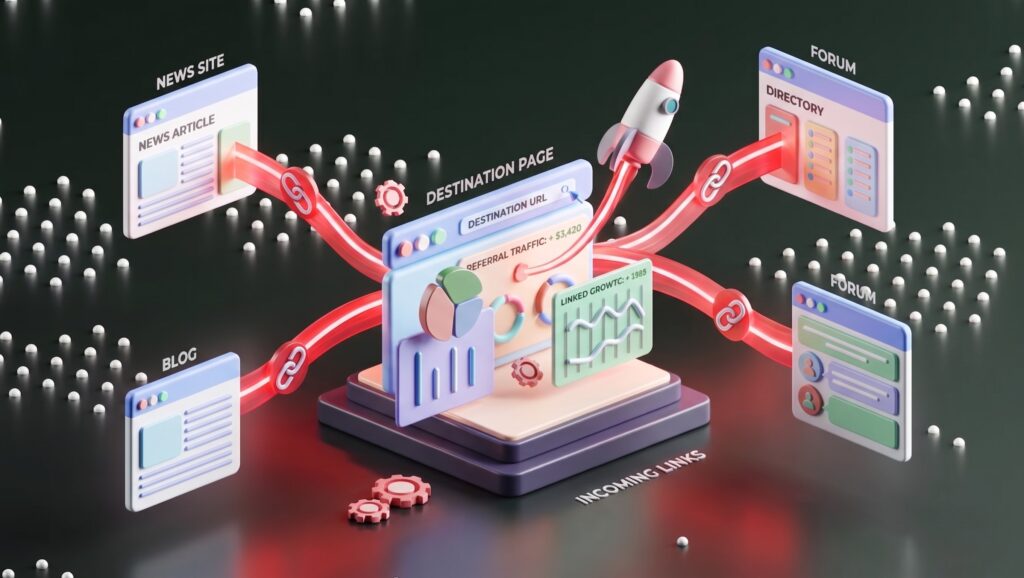
A backlink is a clickable link from a page on one website to a page on another website. If another domain links to your homepage, product page or article, your page has received a backlink. Backlinks are also called inbound links, incoming links or external links pointing to a site.
For example, imagine a news publication links to a retailer’s product guide. The retailer receives the backlink. From the publication’s perspective, the same link is an external or outbound link.
That distinction matters because a backlink is defined by direction. It points from an external domain to the page being discussed.
How Does a Backlink Work?
A standard backlink is usually created with an HTML anchor element:
<a href=”https://example.com/running-shoe-guide”>running shoe guide</a>
The code contains three important parts:
- Destination URL: The href value tells the browser which page to open.
- Anchor text: The visible words describe the linked page and give the reader a reason to click.
- Source page: The page containing the link supplies the surrounding context, including the topic and reason for the reference.
When a person clicks the link, they move from the source page to the destination page. Search engine crawlers can also follow crawlable links to discover content. Google states that it uses links to find new pages and as a signal when assessing page relevance in its link best practices.
A link should use an <a> element with an href attribute if it needs to be reliably crawlable. Buttons, JavaScript click events and text that merely looks like a URL may work for a visitor but are not always parsed as links by search engines.
What Is the Difference Between a Backlink, Internal Link and External Link?
These terms describe where a link starts and ends. They are related, but they are not interchangeable.
| Link Type | Direction | Example | Main Purpose |
| Backlink | Another domain to your domain | A newspaper links to your research | Sends visitors and provides an external reference |
| Internal link | One page to another page on the same domain | A service page links to a related guide | Helps users and crawlers find connected content |
| External link | Your domain to another domain | Your article links to a government source | Supports a claim or directs readers to another resource |
One link can have two descriptions. A link from Site A to Site B is an external link for Site A and a backlink for Site B. An internal link never becomes a backlink because both pages sit on the same domain.
Why Are Backlinks Important for SEO?
Backlinks matter because the web is connected through links. Search engines use those connections alongside many other signals to find, interpret and rank pages.
- Page discovery: A crawlable backlink gives search engine crawlers another path to a page. This can help them find new or updated URLs, although discovery does not guarantee indexing.
- Relevance signals: The anchor text, surrounding copy and source-page topic can help clarify what the destination page covers.
- Link analysis: Google’s ranking systems examine how pages link to one another to help determine what pages are about and which may be useful for a query. PageRank remains part of Google’s core ranking systems, but it operates within a much larger system, as explained in Google’s ranking systems guide.
- Referral traffic: A well-placed link can send qualified visitors directly to a page, even if rankings do not change. Links from pages with a relevant audience usually have more commercial value than links no one sees.
- Independent validation: An editorial link shows that another publisher considered the destination useful enough to reference. Repeated citations from trusted, relevant sources can strengthen how people perceive a business or author.
Backlinks are not a shortcut to rankings. Google uses many signals, and its SEO Starter Guide makes clear that links are only one part of Search. A page still needs to satisfy the search intent, offer useful information and work properly.
What Makes a Good Backlink?
A good backlink is earned for a clear editorial or practical reason. Its value comes from the combination of source quality, relevance, placement and audience, not from a single metric.
| Quality Factor | What to Look For | Why It Matters |
| Topical relevance | The source page and destination cover closely related subjects | The connection makes sense to readers and search engines |
| Editorial reason | The publisher chose the link because it supports the content | A genuine citation carries more meaning than a planted link |
| Credible source | The site has real authorship, useful content and a sound reputation | Trust in the source affects how persuasive the reference is |
| Contextual placement | The link appears within relevant copy rather than an unrelated footer or list | The surrounding text explains why the destination is useful |
| Descriptive anchor text | The linked words accurately describe the destination | Readers can predict what they will find after clicking |
| Real audience | The source page attracts people who may care about the destination | The link can produce visits, enquiries or sales as well as SEO value |
| Accessible destination | The linked URL returns a valid page and can be crawled | A broken, redirected or blocked destination weakens the experience |
Third-party scores such as Domain Authority and Domain Rating can help compare websites within a tool, but they are not Google metrics. A high score does not make an irrelevant, paid or poorly placed link a good backlink. Review the actual page before judging the number beside it.
What Are the Main Backlink Attributes?
Publishers can add a rel attribute to a link to describe their relationship with the destination. These attributes help search engines interpret why a link exists.
| Link Description | Example | Appropriate Use |
| Standard link | <a href=”https://example.com”>Example</a> | A normal editorial reference that needs no qualifier |
| Nofollow | <a href=”https://example.com” rel=”nofollow”>Example</a> | A link where the publisher does not want to imply an endorsement or when another value is not suitable |
| Sponsored | <a href=”https://example.com” rel=”sponsored”>Example</a> | Advertising, sponsorships, paid placements or other compensated links |
| UGC | <a href=”https://example.com” rel=”ugc”>Example</a> | Links within user-generated content, such as comments or forum posts |
People often call a standard link a “dofollow backlink”, but dofollow is not an HTML attribute. It usually means the link has no nofollow, sponsored or ugc qualifier.
Google treats these rel values as hints when deciding which links to consider within Search. Paid links should use sponsored, although nofollow remains acceptable. Google’s outbound link qualification guide provides the current requirements.
What Is Anchor Text in a Backlink?
Anchor text is the clickable wording attached to a link. It helps a person understand the destination before opening it and gives search engines contextual information about the linked page.
Common anchor text types include:
- Branded anchor: The business, publication or product name is the clickable text.
- Descriptive anchor: A concise phrase explains the destination, such as “beginner’s guide to trail running”.
- Partial-match anchor: The wording includes part of a target topic within a natural phrase.
- Exact-match anchor: The clickable words exactly match a search query or target keyword.
- URL anchor: The web address itself is used as the clickable text.
- Generic anchor: Broad wording, such as “read more” or “this page,” is used without much context.
Clear, natural anchor text is usually the best choice for users. Repeating keyword-heavy exact-match anchors across arranged links can look manipulative. The wording should fit the sentence and honestly describe the destination rather than being forced around a ranking target.
Are All Backlinks Good for SEO?
No. Some backlinks are valuable, many are neutral, and manipulative links can create risk.
A harmless but weak backlink may come from an unrelated page with no audience. It might add little value without actively harming the site. Search engines can also ignore links they consider unhelpful or artificial.
Risk increases when links are created mainly to influence rankings rather than serve readers. Google’s spam policies identify practices such as buying links for ranking purposes, excessive reciprocal linking and using automated programs to create links.
Warning signs include:
- Paid links without qualification: Payment, products or services are exchanged for a ranking link that is not marked sponsored or nofollow.
- Private link networks: Sites are built or repurposed primarily to pass links rather than serve a genuine audience.
- Automated placements: Software creates large volumes of forum, comment, profile or low-quality page links.
- Irrelevant insertions: A link is forced into content that has no logical relationship with the destination.
- Excessive exchanges: Two sites or groups repeatedly trade links for ranking purposes rather than editorial value.
- Manipulated anchor text: Arranged links repeatedly use the same commercial keyword in an attempt to influence relevance.
The practical test is simple: would the link still be useful if search engines did not count it? If the answer is no, the placement deserves closer review.
How Can You Check a Website’s Backlinks?
Google Search Console is the best first-party starting point for a verified website. Its Links report shows examples of top linking sites, top linked pages and commonly used link text. Google describes the report as a sample, so it should not be treated as a complete list of every backlink.
Third-party backlink tools maintain their own web indexes. They can provide additional information about new and lost links, referring domains, anchor text and estimated authority. Two tools may report different totals because they crawl different pages and refresh their databases at different times.
When reviewing the data, examine the source rather than relying on the headline count:
- Confirm the link exists: Open the source page and check that the link still points to the expected destination.
- Review the exact page: Assess its topic, authorship, content quality and likely audience instead of judging only the domain.
- Check the attribute: Identify whether the link is standard, nofollow, sponsored or ugc.
- Inspect the destination: Make sure the linked page is live, relevant and not caught in an unnecessary redirect chain.
- Look at the surrounding copy: Confirm that the anchor and sentence give the link a legitimate reason to be there.
- Group links by referring domain: One hundred sitewide links from a single domain do not represent one hundred independent endorsements.
The report should support a quality review, not become a target for accumulating the largest possible number.
How Are Backlinks Earned?
Backlinks are earned when a page gives another publisher something worth citing or sharing. The strongest opportunities usually start with a useful asset, a credible relationship or a relevant story.
- Original resources: Research, statistics, calculators, templates and detailed guides give writers a specific source to reference.
- Digital PR: Newsworthy data, expert commentary and timely stories can earn coverage from publications whose readers match the topic.
- Industry relationships: Suppliers, associations, professional partners and event organisers may maintain legitimate resource or member pages.
- Unlinked mentions: A publisher that has already named a brand, product or study may add a link when it improves the article for readers.
- Useful contributions: A subject specialist can supply an accurate quote, example or explanation that strengthens another publisher’s work.
- Broken-link replacements: A publisher may replace a dead reference when an existing page offers a genuinely suitable alternative.
The outreach message cannot compensate for a weak destination. Before asking for a link, make the page accurate, distinctive and easy to cite.
How Should Backlink Performance Be Measured?
Backlink performance should be tied to business and search outcomes. A rising link count can look impressive while producing no useful result.
Use a balanced set of measures:
- Relevant referring domains: Track new domains that have a credible reason to link, not just the total number of URLs.
- Organic visibility: Monitor whether the linked page gains impressions, rankings and search traffic for relevant queries.
- Referral visits: Measure users who arrive through the source link and assess their engagement on the destination page.
- Conversions: Record enquiries, purchases, sign-ups or other actions generated by referral visitors where attribution is available.
- Link retention: Check whether important links remain live and continue pointing to the correct page.
- Anchor and destination distribution: Review whether links point naturally across useful pages and use varied, accurate wording.
Movement cannot always be attributed to one backlink. Content updates, internal links, technical changes, competitors and search system updates may occur at the same time. Look for patterns across a sustained campaign rather than promising that a particular link will create a particular ranking.
Not Sure Whether Your Backlinks Are Helping?
A backlink report is easy to export. Knowing which links matter, which opportunities are missing and which patterns create risk takes a closer review.
Aidan Coleman SEO can assess your existing profile through a backlink audit and build a focused plan through its link-building services. Get in touch to turn backlink data into clear priorities tied to rankings, relevant traffic and revenue.
Call us