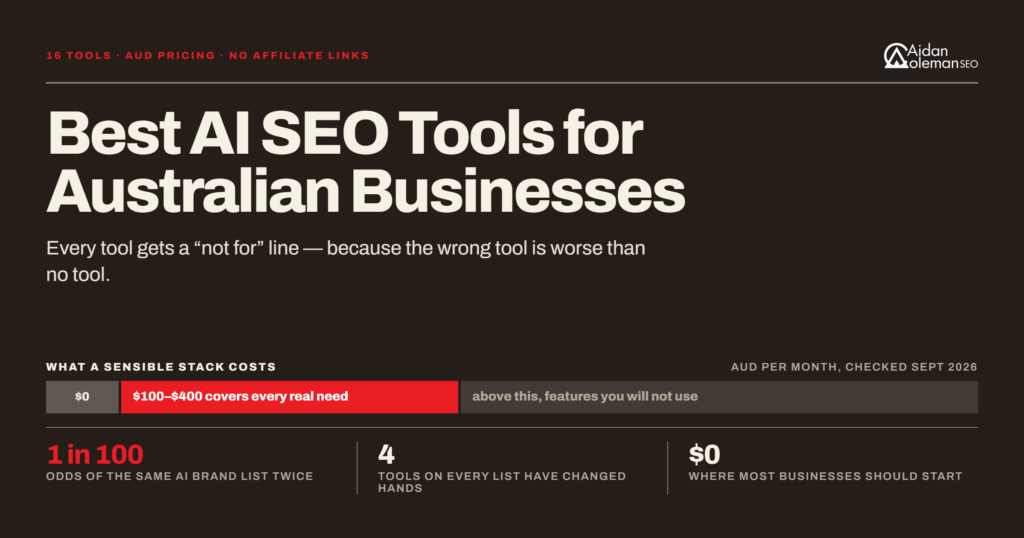
Most “best AI SEO tools” lists are affiliate pages in disguise. Sixteen tools, sixteen glowing reviews, no mention of what any of them cost in Australian dollars or which ones you genuinely do not need.
This one is different in two ways. Every tool has a “not for” line, because the wrong tool is worse than no tool. And the AI visibility section opens with the research showing that a good chunk of what those tools sell you is statistical noise.
I use some of these daily for clients. Others I have trialled and would not buy. I will tell you which is which.
Key Takeaways
- “AI SEO tools” means two different things. Tools that use AI to do normal SEO faster, and tools that track whether AI mentions your brand. Most lists mash them together. They solve completely different problems.
- AI rank tracking is largely noise. Research across 2,961 prompt runs found less than a 1 in 100 chance of getting the same brand list twice from the same prompt.
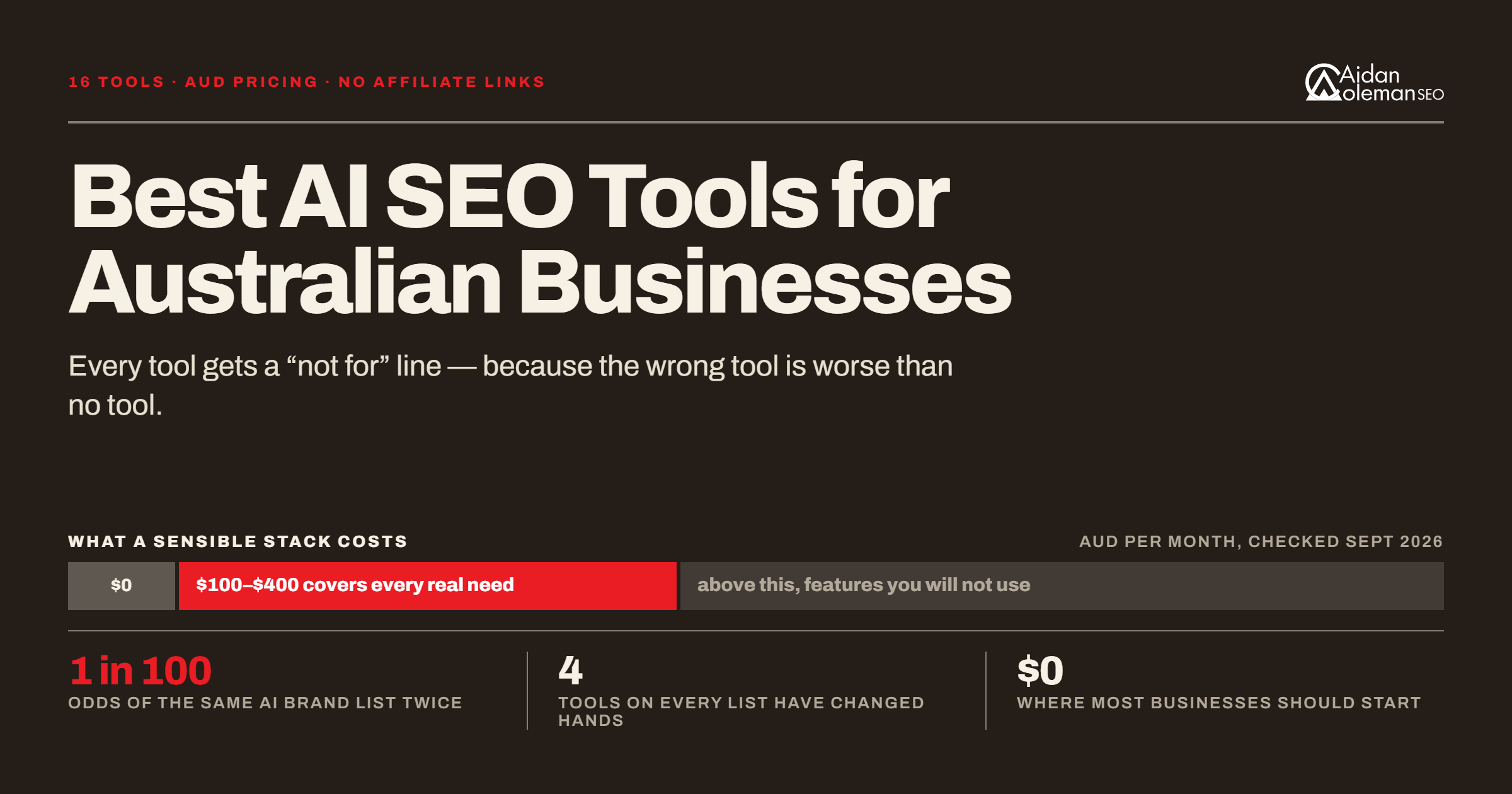
- For most Australian small businesses, the right stack runs a few hundred a month, not thousands. One all-in-one, one content tool, and the free Google and Bing AI reports.
- Four tools on every other list have changed hands, including Semrush being bought by Adobe in April 2026.
- Start free. Search Console now reports AI visibility, and Bing’s version is better. Both cost nothing.
First, Two Very Different Things Are Being Sold to You
Before any tool list makes sense, you need to separate these.
Category A: AI-powered tools for normal SEO. Software that uses AI to speed up keyword research, content briefs, on-page optimisation, technical audits and reporting. This is what “AI SEO” meant before 2024 and it is still where most of the value sits.
Category B: AI search visibility tools. Software that tracks whether you get mentioned in ChatGPT, Google AI Overviews, AI Mode, Perplexity, Gemini or Copilot. Sometimes called GEO or AEO tools. New, expensive, growing fast.
Category A helps you rank and convert. Category B tells you whether machines are talking about you. They are not substitutes.
Aleyda Solís, who has been as clear-eyed on this as anyone, makes the point that AI search optimisation is not a separate discipline from SEO, and treating it as one can backfire because it hides the fact that SEOs are already best placed to do the work.
My advice for most Australian businesses: get Category A right first. Add Category B only when you can see AI referrals in your analytics.
Quick Comparison
| Tool | Category | Best for | From (AUD/mo) | Free option |
|---|---|---|---|---|
| Semrush | All-in-one | Doing everything in one login | ~$217 | 7-day trial |
| SE Ranking | All-in-one | Best value for AU small business | ~$81 | 14-day trial |
| Ahrefs | All-in-one | Backlinks and competitor research | ~$200 | Webmaster Tools |
| Surfer SEO | Content | Optimising articles at volume | ~$76 | No |
| Frase | Content | Budget briefs and optimisation | ~$60 | 7-day trial |
| Clearscope | Content | Premium content teams | ~$200 | No |
| Otterly.AI | AI visibility | Cheapest credible entry | ~$45 | No |
| Peec AI | AI visibility | Agencies tracking several brands | ~$124 | No |
| Ahrefs Brand Radar | AI visibility | Existing Ahrefs users | ~$308 add-on | No |
| Semrush AI Visibility | AI visibility | Widest engine coverage | ~$153 | No |
| Profound | AI visibility | Enterprise only | ~$153 | No |
| BrightLocal | Local | Tradies and clinics | ~$60 | 14-day trial |
| Local Falcon | Local | Geo-grid rank checking | ~$39 | 100 credits |
| Search Console | Free | Everyone | Free | Yes |
| Bing Webmaster Tools | Free | AI citation data | Free | Yes |
| SEOptimer | Audits | Australian-built reporting | ~$29 | 14-day trial |
Checked September 2026. Most of these bill in US dollars, so the AUD figure moves with the exchange rate.
Part One: AI Tools for Normal SEO
1. Semrush
The most complete platform on the market, and the default recommendation for a reason.
What it does. Keyword research, rank tracking, site audits, backlink analysis, content optimisation, local listings, competitor research and now AI visibility tracking, across more than 55 tools in one login.
Standout feature. Breadth. Nothing else covers this much ground, and the Australian keyword database is genuinely deep for .com.au.
Best for. In-house marketers and agencies who would rather pay once than stitch five tools together.
Not for. Anyone who only needs one job done. You will pay for 50 tools and use four.
Pricing. Roughly AU$217, AU$387 and AU$775 a month for Pro, Guru and Business. Annual billing saves about 17%. Semrush One, which bundles AI visibility, runs around AU$308 to AU$928.
Rating. 4.5 out of 5 on G2 from around 3,400 reviews.
One thing to know. Adobe completed its US$1.9 billion acquisition of Semrush in April 2026. No pricing changes yet, but worth knowing who owns your data.
Bottom line. If you buy one paid tool and budget is not the constraint, buy this.
2. SE Ranking
The value pick, and the one I most often recommend to Australian small businesses.
What it does. Everything Semrush does at maybe 80% of the depth, for about a third of the price. Keyword research, rank tracking with city-level Australian data, audits, content tools, and AI Search tracking across five engines.
Standout feature. AI Search tracking is an add-on rather than an enterprise tier, and the API and MCP access are included on all plans.
Best for. Australian SMBs, solo consultants and anyone who found Semrush’s invoice hard to justify.
Not for. Enterprise teams needing the deepest backlink index. Ahrefs still wins there.
Pricing. From around AU$81 a month. Higher tiers scale with keyword and project limits.
Rating. 4.7 out of 5 on G2 from around 2,400 reviews.
Bottom line. The best value all-in-one for this market. If your budget is under $200 a month, start here.
3. Ahrefs
Still the gold standard for backlinks, and its AI features have quietly caught up.
What it does. The best backlink index in the business, plus keyword research, rank tracking, site audits, AI Content Helper and AI Overview detection built into the base plans.
Standout feature. Link data. Nothing else comes close for understanding why a competitor outranks you.
Not for. Teams needing multiple seats on a budget. Every plan includes one seat and extra seats run roughly AU$62 to AU$124 each, which adds up fast.
Pricing. Around AU$200 a month for Lite, rising to roughly AU$386, AU$696 and AU$2,323 for Standard, Advanced and Enterprise. Ahrefs Webmaster Tools is free for your own verified site.
Rating. 4.5 out of 5 on G2 from around 690 reviews.
Bottom line. If your growth problem is authority rather than content, this is the one. Most businesses do not need both this and Semrush.
4. Surfer SEO
The content optimiser most writers actually stick with.
What it does. Scores your draft against the pages currently ranking, tells you what to add, and now includes Auto-Optimize, audits, an AI writer and AI mention tracking.
Standout feature. The Content Editor workflow. Write in it, watch the score move, publish.
Best for. Anyone publishing more than four articles a month, and agencies briefing freelance writers.
Not for. Backlinks or deep technical work. It is deliberately narrow. Also not worth it if you publish once a month.
Pricing. From around AU$76 a month at the entry tier, up to roughly AU$153, AU$282, AU$463 and AU$1,548 as you climb. Annual saves roughly 17 to 20%. No free tier.
Rating. 4.8 out of 5 on G2 from around 545 reviews.
Bottom line. Best-in-class at one job. Pair it with an all-in-one rather than expecting it to replace one.
5. Frase
The budget option that punches well above its price.
What it does. Research, content briefs and on-page optimisation in one workflow, and in 2026 it folded AI visibility tracking into every tier.
Standout feature. Getting two jobs done cheaply. For a solo operator, this is often the only content tool needed.
Not for. Volume publishers. The entry plan caps at 50 pages, and enterprise teams will outgrow it quickly.
Pricing. Around AU$60 a month on annual billing or AU$76 monthly. Pro and Scale tiers run roughly AU$178 to AU$370. Seven-day trial, no card required.
Rating. 4.8 out of 5 on G2 from around 310 reviews. Worth noting its Trustpilot score is far lower, so trial it properly before committing.
Bottom line. Best value content tool for a one-person operation.
6. Clearscope
The premium content optimiser, and the one most enterprise content teams settle on.
What it does. Content grading and keyword recommendations, done more simply and more accurately than most competitors.
Standout feature. Unlimited users on every plan, which makes it cheaper than it looks once you have three or more writers.
Not for. Budget-conscious buyers or anyone needing topical strategy. It grades pages, it does not plan sites.
Pricing. Around AU$200 a month for Essentials and AU$618 for Business, with Enterprise on request. Add-on topics cost roughly AU$23 to AU$39 each.
Rating. 4.9 out of 5 on G2 from around 90 reviews.
Bottom line. If Surfer feels cluttered and you have the budget, this is the cleaner tool. For most Australian SMBs it is overkill.
Part Two: AI Visibility Tools, and the Research You Should Read First
Before I list a single one of these, you need to know what the research says, because the entire category is built on a premise that does not fully hold.
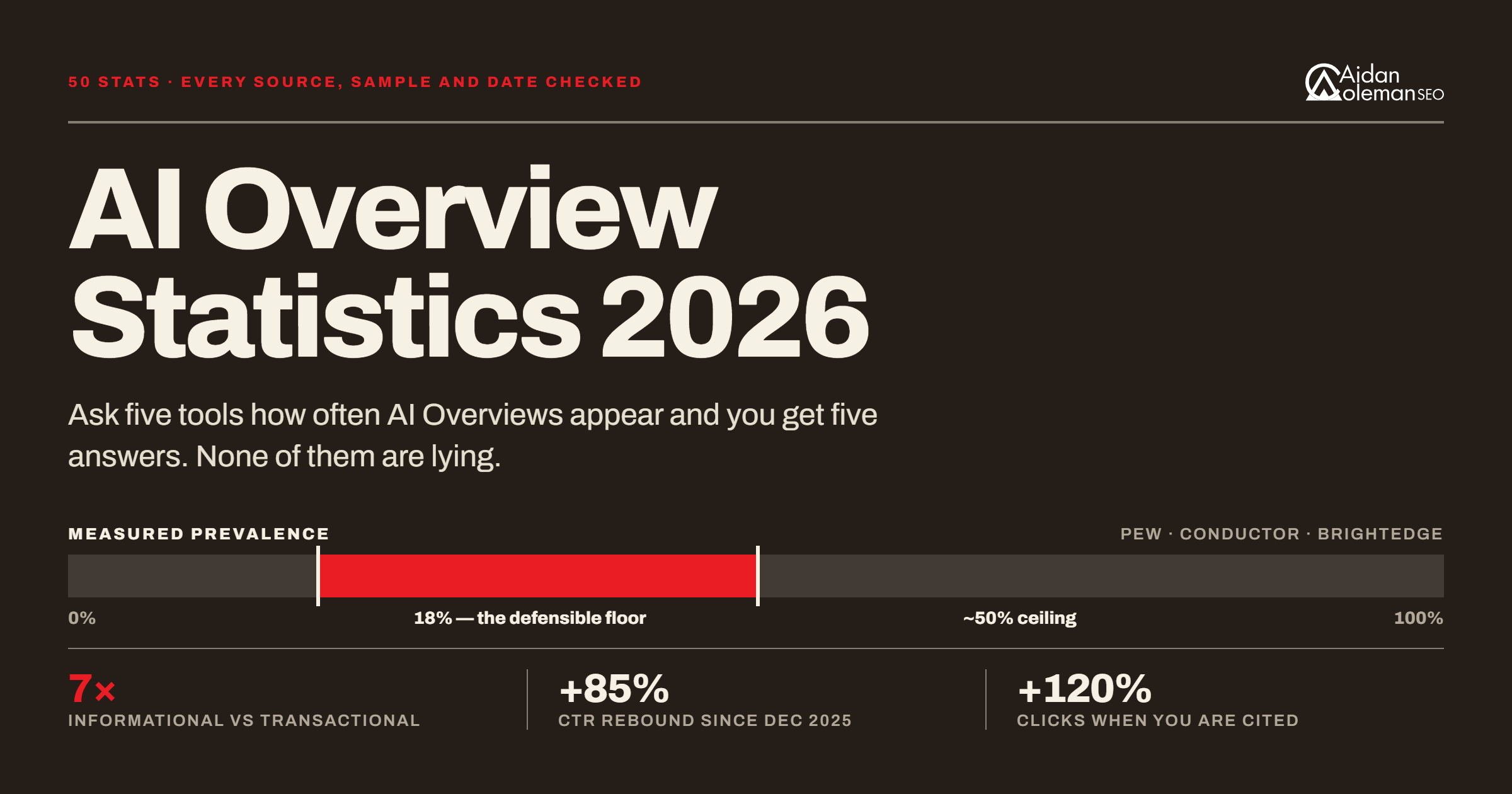
Rand Fishkin of SparkToro and Patrick O’Donnell of Gumshoe ran 2,961 prompts through ChatGPT, Claude and Google’s AI with 600 volunteers over November and December 2025. Twelve categories, each prompt run 60 to 100 times per platform.
The findings:
- Less than a 1 in 100 chance of getting the same list of brands twice from the same prompt.
- Roughly 1 in 1,000 odds of getting that list in the same order.
- Even the number of items changed, sometimes three, sometimes more than ten.
Fishkin’s conclusion was blunt: any tool giving you a “ranking position in AI” is, in his words, full of baloney.
But one metric survived. The consideration set is stable. Top brands in each category appeared in 55% to 77% of responses regardless of how the prompt was phrased. Sony, Bose and Apple showed up in nearly every headphones run.
So here is how to read this category honestly. These tools cannot tell you your AI ranking, because there is no such thing. They can tell you roughly how often you turn up. Presence, not position. Anyone selling you “you rank third in ChatGPT” is selling you a coin flip with a dashboard on it.
That is not a reason to avoid the category. It is a reason to buy the cheap end of it, ask any vendor to show their methodology, and treat the number as a rough gauge rather than a KPI.
With that established:
7. Otterly.AI
The cheapest credible way into this category, and where I would start.
What it does. Tracks brand mentions and citations across ChatGPT, Google AI Overviews, Perplexity and Copilot, on every plan, plus GEO audits.
Standout feature. The price, and four engines on the entry tier rather than one.
Not for. Anyone needing prompt depth. The entry plan tracks 15 prompts, which is a pilot rather than a programme.
Pricing. From around AU$45 a month, rising to roughly AU$293 and AU$758. Extra prompts cost about AU$153 per hundred. Unlimited seats on all plans, and annual saves 15%.
Rating. 4.9 out of 5 on G2, though from only around 41 reviews.
Bottom line. Forty-five dollars a month to find out whether AI mentions you at all. That is a reasonable experiment for almost any business.
8. Peec AI
The mid-market and agency option, and the nicest of these to actually use.
What it does. Daily prompt monitoring across selected models with clean multi-country reporting and sentiment analysis.
Standout feature. Per-country tracking and a genuinely good interface, which matters when you are showing clients.
Not for. Solo businesses, and anyone expecting it to fix things. It reports, it does not act.
Pricing. From around AU$124 a month on annual billing, rising to roughly AU$380 and AU$767. You pick three models, with extra models costing about AU$47 to AU$217 each. No free tier.
Rating. 4.9 out of 5 on G2, but from only about a dozen reviews.
Bottom line. If you manage several brands and need client-ready reporting, this is the pick.
9. Ahrefs Brand Radar
The sensible choice if you already pay for Ahrefs.
What it does. Tracks brand mentions across ChatGPT, Perplexity, Gemini, Copilot, AI Overviews and AI Mode, built on a large prompt index so you can look up any brand instantly with history.
Standout feature. No cold start. Most tools begin collecting the day you sign up. This one already has the data.
Not for. AI-only buyers. It sits on top of an Ahrefs subscription, so full coverage lands somewhere around AU$1,280 to AU$1,780 a month all in. It also does not track Claude, and chatbot indexes refresh monthly by default rather than daily.
Pricing. Roughly AU$308 per index or AU$1,083 for all indexes, on top of your base plan. Ahrefs quotes two different figures on its own site, so confirm at checkout.
Bottom line. Great value as an add-on, poor value as a reason to join Ahrefs.
10. Semrush AI Visibility Toolkit
The widest engine coverage in one place.
What it does. Visibility scoring, prompt tracking, brand performance and cited-URL analysis across seven engines including Claude and DeepSeek, refreshed daily.
Standout feature. Seven engines and daily refresh, in the same login as your keyword and rank data.
Not for. Anyone not already in the Semrush ecosystem, since the standalone price is per domain.
Pricing. Around AU$153 a month per domain standalone, or bundled into Semrush One from roughly AU$308.
Bottom line. If you already run Semrush, this is the obvious add. One domain, seven engines, about a hundred and fifty a month.
11. Profound
The enterprise leader. Included for completeness, not because most readers should buy it.
What it does. Runs thousands of structured prompts daily across ChatGPT, Perplexity, AI Overviews, Copilot and Claude, with conversation analytics and agent traffic reporting.
Standout feature. It publishes its own sampling maths, roughly 9,000 responses a month against 100 prompts. Given Fishkin’s point about showing your working, that transparency matters more than the feature list.
Not for. Anyone reading this article, honestly. It is built for enterprise analysts.
Pricing. Entry sits around AU$153 a month but is annual-only and ChatGPT-only at that tier. Realistic plans run roughly AU$515 to AU$2,323.
Rating. 4.6 out of 5 on G2 from around 320 reviews, skewed enterprise.
Bottom line. The category leader, and the one that raised US$96 million at a billion dollar valuation in February 2026. Know it exists. Do not buy it as an Australian SMB.
Part Three: Local SEO Tools with AI Features
If you are a tradie, a clinic or any business with a service area, these matter more than anything in Part Two.
12. BrightLocal
The best all-in-one local SEO tool, and now with AI visibility built in.
What it does. Local rank tracking, citation building and auditing, Google Business Profile audits, review management, geo-grid reporting, and a Local AI Visibility Tracker showing how you appear across ChatGPT and Google’s AI features.
Standout feature. The AI visibility tracker is aimed at local businesses specifically, which almost nothing else in the GEO category does.
Not for. National or ecommerce brands. It is built for local.
Pricing. Track plan from around AU$60 a month. Managed services cost considerably more. Fourteen-day trial.
Rating. 4.6 out of 5 on G2 from around 230 reviews.
Bottom line. For a local Australian service business, this does more useful work per dollar than any AI visibility tool on this page.
13. Local Falcon
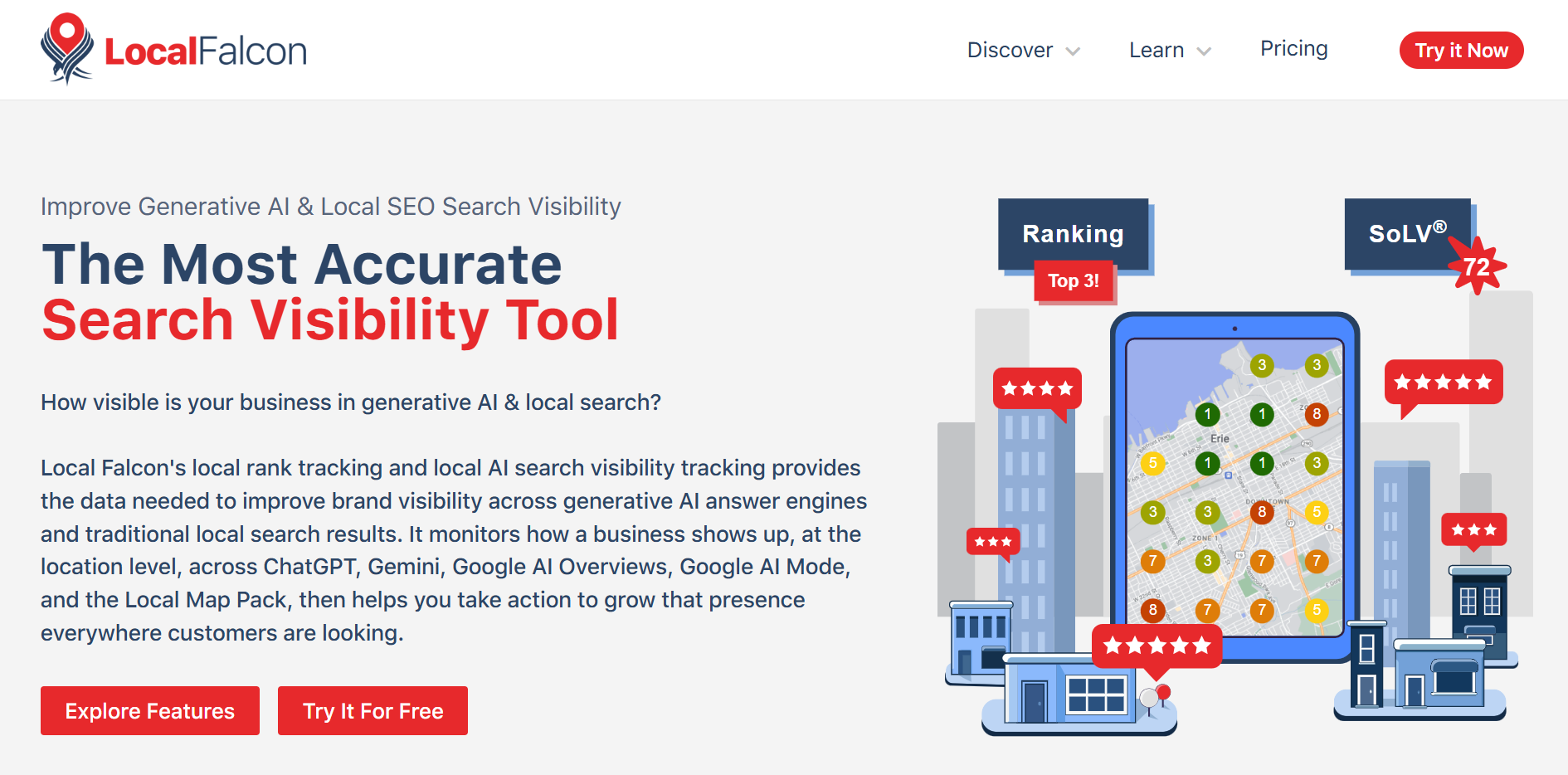
The geo-grid tool, and the clearest way to see how ranking changes across a suburb.
What it does. Shows your Map Pack ranking across a grid of points around your location, so you can see exactly where you are visible and where you disappear. Its AI Search Visibility module re-runs prompts across that same grid on ChatGPT, Gemini, AI Overviews, AI Mode and Grok, on every plan.
Standout feature. Geographic AI visibility. Knowing you appear in AI answers is one thing. Knowing you appear in Bondi but not Randwick is actionable.
Not for. Managing anything. It measures, you act.
Pricing. Credit-based, from around AU$39 up to AU$310 a month. One hundred free credits to try it.
Bottom line. Pairs well with BrightLocal rather than competing with it. One measures geographically, the other manages.
Part Four: The Free Stack Most Businesses Should Start With
14. Google Search Console and Bing Webmaster Tools
Both free, and between them they now cover AI visibility better than some paid tools.
Search Console rolled out its Search Generative AI performance reports to all sites worldwide in August 2026. It shows your visibility inside Google’s AI features for Search and Discover, broken down by page, country and device. The catch is that it reports impressions rather than clicks and gives no query data.
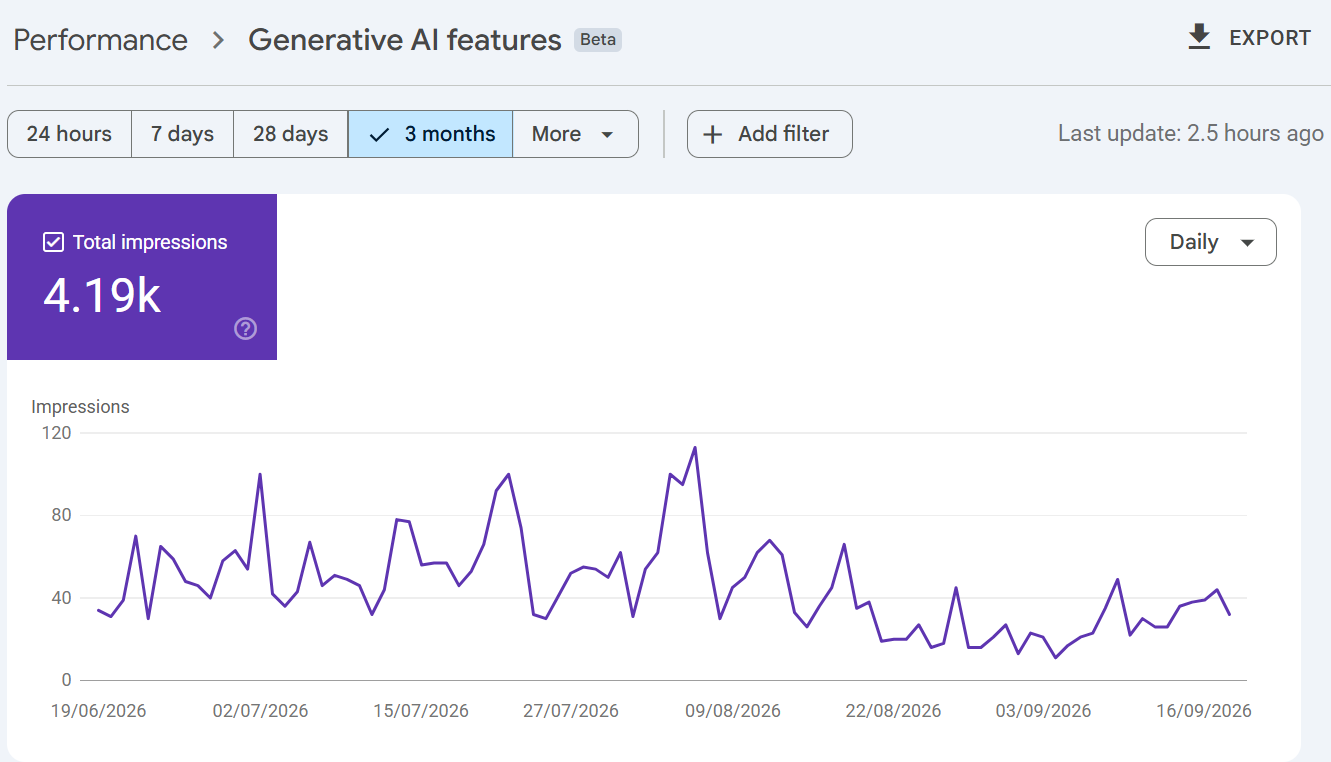
Its official documentation also confirms that AI Overview and AI Mode traffic is folded into the “Web” search type in the main Performance report, so there is no separate filter.
Bing Webmaster Tools launched its AI Performance report in February 2026 and is currently ahead of Google on detail. It shows citations in Copilot and Bing’s generative answers, which URLs were cited, and the grounding queries behind them.
Bottom line. Before you spend a dollar on AI visibility tracking, set these up. They are free, they are first-party, and Bing’s is genuinely good.
15. ChatGPT, Claude and Gemini Used Directly
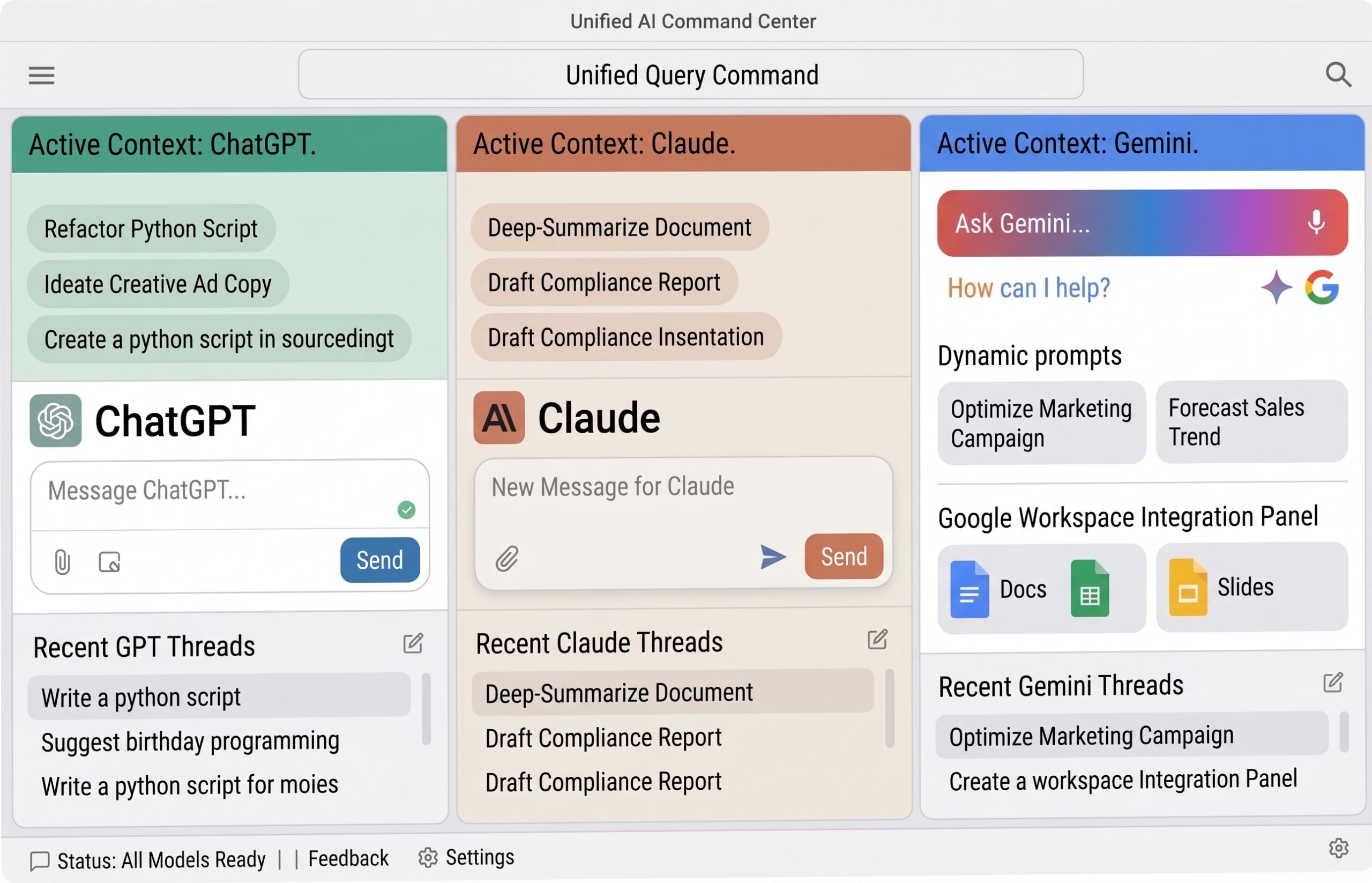
The most underrated AI SEO tools are the models themselves, without a wrapper charging you a subscription for access.
What they do well. Content briefs, meta descriptions, FAQ drafting, schema markup, keyword clustering from an exported list, turning a messy audit into a prioritised action list, and rewriting for clarity.
What they do badly. Anything requiring real data. They do not know your rankings, your traffic or your backlinks, and they will confidently invent search volumes if you let them.
Cost. Around AU$31 a month each. Free tiers are usable for most of the above.
Bottom line. A large share of “AI SEO tools” on the market are thin wrappers around these models. Learn to prompt properly and you will not need several of them.
Part Five: The Australian Option
16. SEOptimer
Worth knowing because it is built in Melbourne, which almost nothing else on this list can claim.
What it does. Site audits and white-label PDF reporting, an embeddable audit widget for lead generation, keyword and backlink tracking, plus newer GEO audit and Google Business Profile tools.
Standout feature. The embeddable audit widget. If you run an agency or a service business, putting a free audit tool on your site is a genuinely effective lead magnet.
Not for. Deep keyword or backlink research. It is an audit and reporting tool, not an all-in-one.
Pricing. From around AU$29 to AU$91 a month. Fourteen-day trial.
Bottom line. Not the most powerful tool here, but the reporting is clean and it is the clearest Australian-built option in the category.
What Should You Actually Buy?
Here is what I would put in front of different businesses.
Solo tradie or local service business. Google Business Profile and Search Console, both free, plus BrightLocal at around AU$60 a month. Add Local Falcon at AU$39 if you serve multiple suburbs. Skip AI visibility tools entirely for now. Total: under AU$100 a month, and local SEO is where your return is anyway.
Multi-location clinic or franchise. BrightLocal or Semrush Local, plus Local Falcon for geo-grid, plus SE Ranking for the site-level work. Around AU$250 a month.
Ecommerce store. Semrush or Ahrefs as the core, Surfer for product and category content, the free Google and Bing AI reports. Add Otterly at AU$45 if you sell in a category people research through AI. Around AU$300 a month.
B2B or SaaS. Ahrefs or Semrush, plus Clearscope or Frase for content, plus a visibility tracker. This is the audience where AI search genuinely matters, since buyers research through ChatGPT constantly. Around AU$400 a month.
Agency or consultant. Ahrefs or Semrush Business, Surfer for client content, and Peec AI if you are tracking several brands. Local Falcon’s credit model scales nicely across clients.
The minimum viable stack, at zero cost. Search Console with its AI report, Bing Webmaster Tools with its AI Performance report, GA4, Google Keyword Planner for real Australian volumes, and ChatGPT or Claude for the writing work. That genuinely covers a lot, and it is where I would start any business that has never done SEO before.
Four Tools That Changed Hands
Most lists still describe these as they were, which tells you how much of this content is copied rather than checked.
Semrush was acquired by Adobe for US$1.9 billion, completed April 2026.
Scrunch AI, which appears on plenty of GEO tool lists as an independent product, was bought by Sitecore for around US$225 million in June 2026 and is now a division rather than a standalone tracker.
MarketMuse was acquired by Siteimprove in late 2024, and its pricing is now demo-only rather than published.
ContentKing became Conductor Website Monitoring, and DeepCrawl became Lumar. Both are still good, but neither exists under the name most articles use.
Red Flags When Buying AI SEO Tools
Anything selling you an “AI ranking position.” Per the research above, that number is noise. Presence and share of voice are the honest metrics.
Vendors who will not show their methodology. Ask how many prompt runs per query, how often they refresh, and which engines they actually hit versus which they claim. Fishkin’s advice is the right test: before you spend a dollar, make sure they show their maths.
Thin ChatGPT wrappers. A large share of cheap “AI SEO tools” are a prompt template with a subscription attached. If you could get the same output by asking Claude directly, you probably should.
Annual lock-in on a new category. This space is changing monthly and several tools have already been acquired or shut down. Pay monthly until you are certain.
Prompt caps designed to force upgrades. Fifteen prompts sounds fine until you realise your customers ask a hundred different questions.
USD billing with no AUD option. Nearly everything here bills in US dollars, so budget for exchange rate movement and check whether GST applies to your invoice.