Your page can mention the right keyword and still fail to rank. The problem is often not a missing phrase. It is an unclear purpose, generic information, competing pages, or important content that search and AI systems cannot reliably read.
This guide explains the on-page SEO factors that matter now, how to use keywords without stuffing them, and why essential proof should appear in your page’s HTML rather than depend entirely on JavaScript.
What Are the Most Important On-Page SEO Factors?
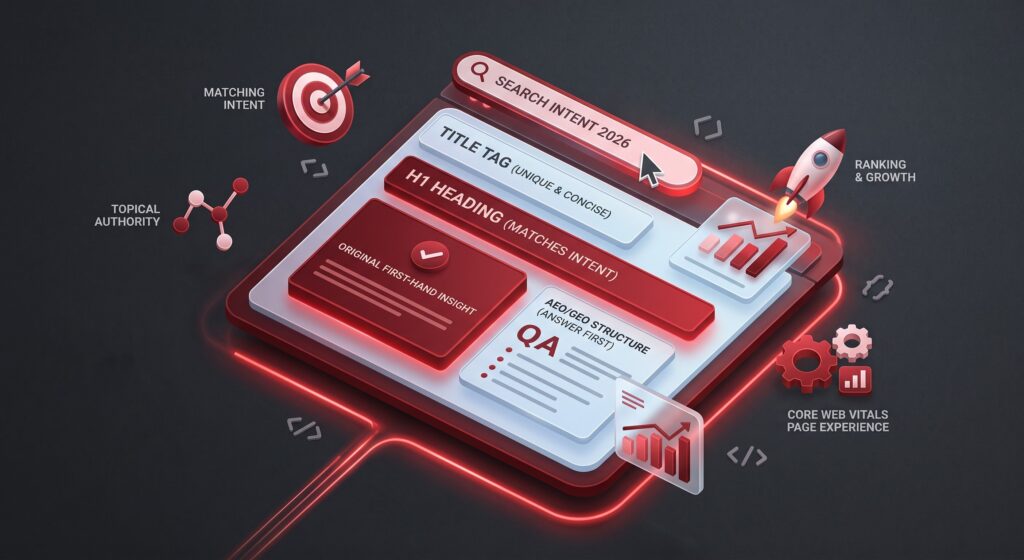
The most important on-page SEO factors are search intent, a focused page topic, an accurate title tag and H1, original content, natural keyword use, logical headings, useful internal links, descriptive URLs, accessible media, and a good page experience. For GEO, critical information should also be available in the initial HTML so AI crawlers can retrieve it.
No element works alone. A well-written title cannot rescue a weak page, and a fast page will not rank for a query it fails to answer. The strongest results come from aligning every element around one clear purpose.
Match the Page to Search Intent
Search intent is the purpose behind a query. A person may want a definition, instructions, a comparison, a local provider, or a product they can buy. The page format and depth should reflect that purpose.
Start by reviewing the current results for the target query. Look at the page types that appear, the questions they answer, and the level of detail users receive. This is not an instruction to copy competitors. It is a way to identify the minimum expectations attached to the query.
Then decide what your page can add. A service page may need proof, inclusions, location details, and a clear next step. An informational article may need a direct answer, examples, and supporting sources. Mixing several intentions on one URL can leave every audience with an incomplete answer.
Keep One Clear Focus Per Page
A focused page has one primary purpose and enough supporting detail to fulfil it. The primary keyword gives that purpose a label, but the content must still answer the underlying need.
Before drafting, define these points:
- Primary query: Choose the main phrase that best represents the page’s search purpose.
- Reader need: State what the visitor should understand or be able to do after reading.
- Content boundary: Decide which related questions belong here and which deserve separate pages.
- Conversion goal: Give the page one logical next action that matches the reader’s stage.
This boundary reduces topic drift and protects future content opportunities. A guide about on-page SEO factors can explain why internal links matter, for example, without becoming a full internal-link audit tutorial.
Align the Title Tag and H1
The title tag and H1 should describe the same page, but they serve different locations. The title tag can appear as the headline in search results and browser tabs. The H1 is the main heading visitors see on the page.
A strong title tag should be unique, specific, accurate, and easy to read. Place the primary topic early when it fits naturally, then use the remaining space to clarify the benefit or angle. Avoid repeated variants that say the same thing.
Google’s title link guidance recommends concise, descriptive title text and specifically warns against keyword stuffing. Google may also create a different title link when the supplied title is vague, repetitive, outdated, or inconsistent with the visible page.
The H1 can be slightly more descriptive than the title tag. It does not need to match word for word. What matters is that both set the same expectation and the body copy fulfils it.
Add Original Information and First-Hand Insight
Original content does more than avoid duplicate wording. It gives the page information that readers cannot get from a reshuffled summary of existing results.
Useful forms of originality include:
- First-hand observations: Explain what testing, implementation, or client work revealed.
- Specific examples: Show how a principle affects a real page, feature, or decision.
- Original data: Publish a clear method, sample size, date, and limitations with any findings.
- Expert analysis: Explain why a result occurred and what should change as a result.
- Practical constraints: Include costs, trade-offs, exceptions, and failure points that generic advice often omits.
Experience should be demonstrated through details, not claimed with labels. A short observation drawn from real work can add more value than another 500 words repeating a standard checklist.
Use Keywords Naturally Instead of Stuffing Them
Keyword stuffing is the excessive or unnatural repetition of terms in an attempt to influence rankings. It can appear in body copy, headings, title tags, anchor text, image alt text, or hidden content.
It no longer works as a sensible optimisation method. Search systems interpret topics through language, entities, context, links, and page structure rather than counting one exact phrase. Google’s spam policies also identify keyword stuffing as a practice that can lead to lower visibility or removal from results.
Use the primary keyword where it helps a reader confirm the topic:
- Title tag: Include it, or a close natural variation, when this produces an accurate title.
- H1: State the page topic clearly without adding several near-identical phrases.
- Opening copy: Confirm the subject early so the reader knows the page is relevant.
- Relevant subheadings: Use the term only when the section genuinely addresses that question.
- Body content: Write naturally, using related language where it improves precision.
- Internal anchor text: Describe the destination without forcing the same commercial phrase across every link.
There is no useful universal keyword-density target. If a phrase sounds repetitive when read aloud, rewrite it. The goal is complete meaning, not a percentage.
Structure the Content for Search, GEO, and AEO
Clear structure helps readers scan a page and helps retrieval systems isolate the passage that answers a question. This is where traditional on-page SEO, generative engine optimisation, and answer engine optimisation overlap.
Use an H1 for the page topic, H2s for major questions, and H3s only when a section needs meaningful subdivisions. Headings should describe the information that follows rather than use vague labels such as “More Details”.
For answer-focused sections, provide a concise response immediately after the heading. Add context, qualifications, examples, or steps below it. Tables work well for exact comparisons, while bullets suit parallel points. Paragraphs are better when the explanation depends on reasoning or context.
Do not split every sentence into a new heading. Excessive fragmentation can make the page harder to follow and produces thin passages without enough context to stand alone.
Build Topical Authority Without Keyword Cannibalisation
Topical authority grows when a site covers related questions through useful, connected pages. Cannibalisation occurs when multiple URLs compete for the same intent and give search engines no clear reason to prefer one.
The issue is not simply using the same keyword on two pages. Two URLs can mention the same subject while serving different needs. The problem starts when their titles, headings, content, and target queries substantially overlap.
Use a simple content map before publishing:
| Page Role | Intended Search Need | Example |
| Core guide | Broad explanation of the topic | On-page SEO factors |
| Supporting article | One distinct follow-up question | Do multiple H1 tags affect SEO? |
| Service page | Commercial evaluation and contact | On-page SEO services |
| Audit page | Diagnostic intent | Technical SEO audit |
Internal links should make those relationships explicit. Link from supporting articles to the core guide where it helps the reader, and use descriptive anchor text that reflects the destination. If two existing pages answer the same query, consolidate the strongest material, redirect the weaker URL when appropriate, or give each page a genuinely different purpose.
Optimise the Supporting Page Elements
Several smaller elements help clarify, present, or support a page. They should be accurate and useful, but they do not replace the main content.
- URL slug: Use short, readable words separated by hyphens, as recommended in Google’s URL structure guidance.
- Meta description: Summarise the page and give searchers a reason to click. It is not a direct Google ranking factor, and Google may generate a different snippet.
- Image alt text: Describe informative images for people who cannot see them. Decorative images generally need empty alt attributes rather than inserted keywords.
- Structured data: Use a supported type that matches the visible page. It can help Google understand content and make a page eligible for certain search features, but it does not guarantee a rich result or higher ranking.
- Canonical tag: Point to the preferred version when duplicate or near-duplicate URLs are necessary. A canonical is a signal, not a substitute for resolving avoidable duplication.
- Core Web Vitals: Improve loading performance, responsiveness, and visual stability. Google recommends good Core Web Vitals, but relevance and content quality still matter more than chasing a perfect score.
Want to Know Which On-Page Factors Are Holding You Back?
On-page problems rarely come from one missing keyword. The real issue may be unclear intent, competing URLs, weak proof, inaccessible JavaScript content, or a page structure that hides the answer.
Aidan Coleman SEO can identify those gaps through a practical SEO audit or review how your pages appear to AI systems through an AI search audit. Get in touch for clear priorities based on what your site and audience actually need.
Call us