
20 SEO Trends for 2026: The Year the Rules Actually Changed
SEO trends in 2026 are not the usual list of small tweaks. Something structural has shifted, and the numbers make it hard to argue with.
Consider one figure. In July 2025, 76% of pages cited in Google’s AI Overviews also ranked in the top 10 of normal search results. By March 2026, that had fallen to 38%. In eight months, the link between ranking well and being quoted by AI was cut in half.
That single change explains most of what follows. Ranking still matters. It just no longer does the job it used to do on its own.
Below are the 20 trends shaping search this year, each backed by named research rather than opinion. We’ve grouped them so you can jump to what matters most, and we’ve been honest about which ones are proven and which are still being argued over.
The 20 Trends at a Glance
| # | Trend | Group |
| 1 | AI Overviews become the default result | How search changed |
| 2 | Top 10 rankings stop guaranteeing AI citations | How search changed |
| 3 | AI Mode grows fast, from a small base | How search changed |
| 4 | Clicks fall even for winners | How search changed |
| 5 | Rank tracking loses its place as a main KPI | How search changed |
| 6 | Brand mentions overtake backlinks | What earns visibility |
| 7 | Branded link building replaces generic link building | What earns visibility |
| 8 | Listicle placements become the top-value placement | What earns visibility |
| 9 | YouTube emerges as a major signal | What earns visibility |
| 10 | Earned media beats owned media | What earns visibility |
| 11 | Publishing volume stops working | What earns visibility |
| 12 | AI-assisted, human-led becomes the standard | Content |
| 13 | Original data becomes the real differentiator | Content |
| 14 | Answers move to the top of the page | Content |
| 15 | Structure gets built for extraction | Content |
| 16 | FAQ rich results die, FAQ content survives | Content |
| 17 | Consolidation replaces expansion | Housekeeping |
| 18 | Pruning becomes routine | Housekeeping |
| 19 | Measurement shifts to citations and conversions | Housekeeping |
| 20 | The boring fundamentals still decide everything | Housekeeping |
How Search Itself Changed
1. AI Overviews Become the Default Result
AI-written answers at the top of Google are no longer a test. At Google I/O on 19 May 2026, Google announced AI Mode had crossed 1 billion monthly active users, with AI Overviews reaching 2.5 billion.
For most informational searches, an AI answer now sits above every website on the page. That’s the backdrop for everything else on this list.
2. Ranking in the Top 10 No Longer Guarantees an AI Citation
This is the most important trend of the year, and the least understood.
The old assumption was simple: rank well, and AI will quote you. That link has weakened sharply. Ahrefs data from March 2026 found top 10 organic results now account for only 38% of AI Overview citations, down from 76% in July 2025.
In plain terms, being on page one is now roughly a coin flip for whether AI notices you. Something else decides the rest, and trends 6 through 11 cover what that something is.
3. AI Mode Grows Fast, but From a Small Base
Here’s where a lot of 2026 commentary gets carried away, so it’s worth being precise.
Two things are both true. AI Mode has enormous user numbers, as the Google I/O figures show. But as a share of actual searches, it remains small.
The Q1 2026 State of Search report from Datos, a Semrush company, produced with Rand Fishkin of SparkToro, drew on clickstream data from millions of desktop users across the US, EU, and UK. It found Google AI Mode reaching 0.16% of searches in the US and 0.21% in the EU and UK, with AI tools altogether sitting below 2% of desktop visits. Over the same period, Google recovered to 94.3% search share in the US.
SparkToro’s follow-up research with Similarweb, published in June 2026, put it more bluntly. Looking at January to April 2026, Rand Fishkin found that only 0.34% of searches made their way to AI Mode, concluding that for anyone theorising AI Mode caused the recent shift in search behaviour, it isn’t there yet.
The honest read: this is real growth happening quickly, and it is still a fraction of one per cent of searches. Plan for it, but the thing actually changing your traffic today is AI Overviews, not AI Mode.
4. Clicks Fall Even for the Winners
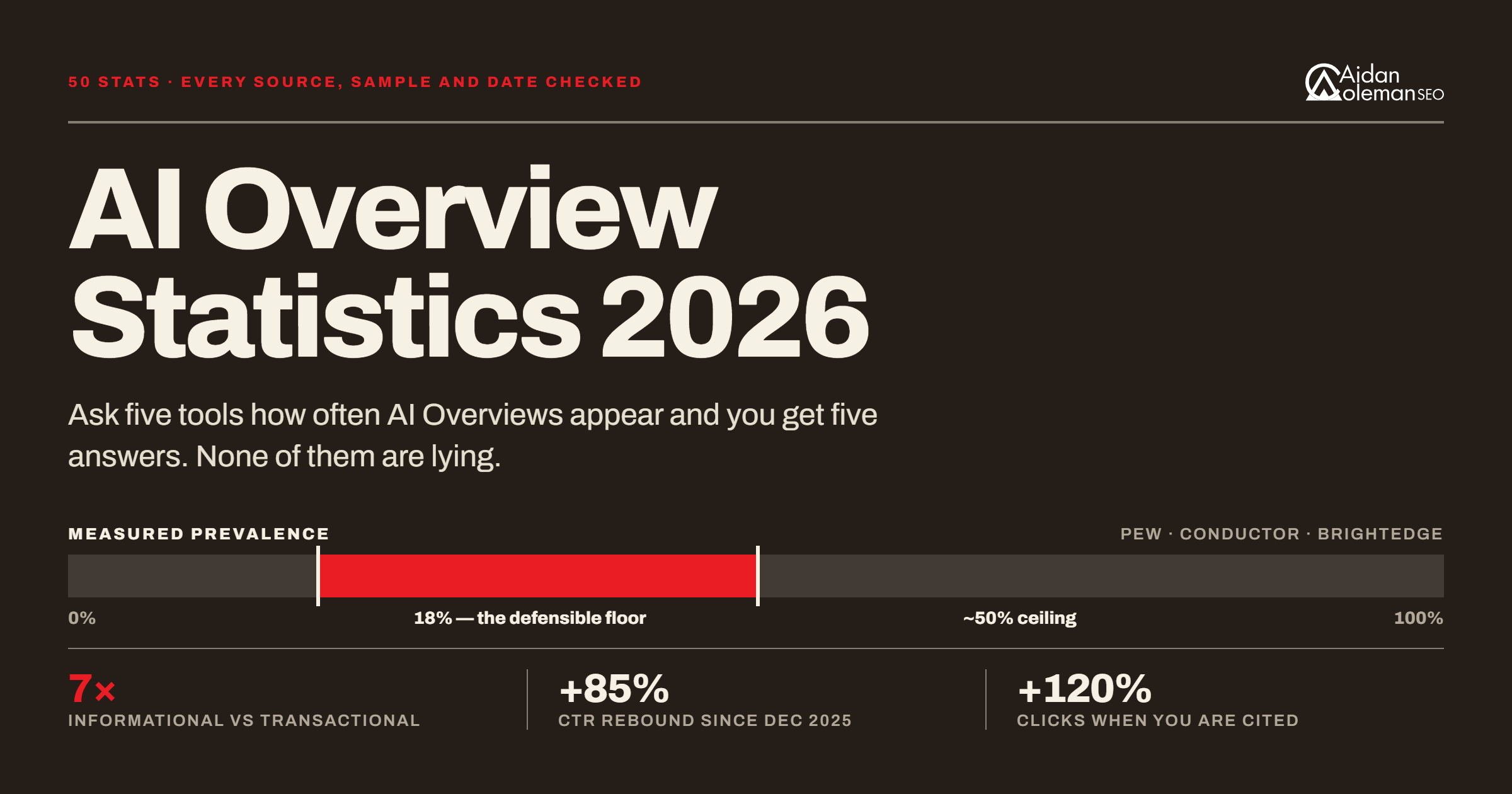
When an AI answer appears, fewer people click anything at all. Research from Pew Research Center found people clicked a traditional result 8% of the time when an AI Overview was present, compared with 15% when it wasn’t.
Ahrefs measured the effect on top-ranked pages directly. Their February 2026 analysis found AI Overviews correlate with a 58% reduction in click-through rate for top-ranking pages, nearly double the 34.5% drop measured in April 2025.
Note what that means. The drop is getting steeper, not levelling off.
5. Rank Tracking Loses Its Place as a Main KPI
Put trends 2 and 4 together and the conclusion follows on its own. You can hold position one, watch your ranking stay perfectly stable, and still lose more than half your clicks to a box above you.
Rankings haven’t become useless. They’re still the best way to see whether a competitor is gaining on you, and whether your page matches what searchers want. But as the headline number on a monthly report, they now hide more than they reveal. We’ve made the full case for why rank tracking is a weak main KPI and what to watch instead.
What Actually Earns Visibility Now
This is where 2026 breaks hardest from previous years.
6. Brand Mentions Overtake Backlinks
The single most quoted piece of research this year comes from Ahrefs, which studied 75,000 brands to see which signals best predict appearing in AI Overviews.
The results reordered the priority list:
| Signal | Correlation with AI Overview visibility |
| Branded web mentions | 0.664 |
| Branded anchor text | 0.527 |
| Brand search volume | 0.334 |
| Domain Rating | 0.326 |
| Referring domains | 0.295 |
| Total backlinks | 0.218 |
Unlinked brand mentions came out roughly three times stronger than backlinks. A brand mention is any named reference to you in credible third-party content, whether or not it links to your site. Reddit threads, podcast notes, review sites, news articles, forum posts.
The gap between the haves and have-nots is stark. Brands in the top 25% of web mentions earn 10 times more AI Overview mentions than the next quartile, and brands in the bottom half are effectively invisible to AI.
One caution before you redirect your whole budget: these are correlations, not proof of cause. Well-known brands get mentioned more and get cited more, and untangling those is genuinely hard. But the size of the gap is difficult to ignore.
7. Branded Link Building Replaces Generic Link Building
The practical version of trend 6 is a change in what link building is even for.
The old model chased links from high-DR domains, largely regardless of context. The 2026 model chases being talked about in the right places, with the link as a bonus rather than the point.
What that looks like in practice:
- Getting named in industry roundups and comparisons, even without a link
- Appearing on review platforms like G2, Trustpilot, or industry-specific equivalents
- Digital PR that earns coverage rather than placements you pay for
- Consistent brand naming across every profile and directory, so AI systems recognise you as one entity
It’s also getting harder, and the people doing it say so. A survey of 518 SEO experts by editorial.link found 55.2% consider link building the most challenging part of SEO, with 75.1% naming the high cost of premium backlinks as their biggest obstacle and 67.2% struggling to scale link building without sacrificing quality.
Authority Hacker’s separate survey of 755 link builders found a similar picture, with 52.3% calling link building the hardest part of SEO. Worth knowing before you judge your provider’s pace.
8. Listicle Placements Become the Highest-Value Placement
If one tactic defines 2026, it’s this one.
Analysis by Evertune Research, published in Search Engine Land on 19 May 2026, reviewed the 6,000 most-cited URLs per model across ChatGPT, Copilot, Gemini, Google AI Mode, AI Overviews, and Perplexity. Of roughly 25,000 unique URLs, half were listicles. Across nearly 400 million citations, 63% pointed to listicle pages.
Ranked lists do particularly well. Evertune’s own figures show that on ChatGPT, 58% of the listicles cited are ranked, numbered lists rather than unordered ones.
The reason is mechanical. When an AI system is asked “what’s the best X,” a numbered list of options is the easiest possible thing to read and reuse. Each entry is a self-contained chunk with a name, a description, and often a price.
The practical shift is that getting your brand into someone else’s “best of” list can be worth more than a conventional guest post. One documented case from Hostinger tracked 67 listicle features for a brand, and found a listicle on a direct competitor’s site drove AI Overview appearances for four months, while most affiliate placements, guest posts, and news mentions dropped out of AI citations within two weeks.
A warning, though. The same research notes that running dozens of listicles all placing your product at number one reads as manipulation. Genuine editorial coverage looks uneven. Manufactured coverage looks suspiciously consistent.
9. YouTube Emerges as a Major Signal
This one surprised most of the industry. In Ahrefs’ December 2025 follow-up study, YouTube mentions emerged as the strongest single signal at roughly 0.737, ahead of branded web mentions.
Semrush’s 2026 AI Visibility Index, built on 126 million AI search prompts, supports the picture from a different angle. It found Gemini cites an average of only 3 sources per response, drawing from a narrow pool that includes Wikipedia, Reddit, and YouTube. When a model only cites three things, being one of them matters enormously.
One useful detail: Ahrefs found the raw number of YouTube mentions mattered slightly more than how many views those videos got. Being mentioned across many small channels beats one viral hit.
10. Earned Media Beats Owned Media
Muck Rack analysed more than one million AI-cited links and found 84% came from earned media.
That’s the cleanest summary of the year’s direction. What other people publish about you now outweighs what you publish about yourself.
There’s a deeper finding behind this. Seer Interactive ran six behavioural tests across 362,188 responses and hypothesised that AI citations are decided after the fact: the model chooses which brands to recommend from what it already knows, then searches for sources to back that up.
If that holds, it changes the whole game. You can’t optimise your way into a recommendation the model has already decided not to make. You have to be known first.
11. Publishing Volume Stops Working
The programmatic content boom is over, and Ahrefs’ data is blunt about why. Their December 2025 study found almost no relationship between the number of pages on a site and its AI visibility, and explicitly noted this contradicts advice recommending programmatic content to drive AI citations.
Mention density across third-party sources drives citations. Page count on your own domain does not.
Content in the AI Era
12. AI-Assisted, Human-Led Becomes the Standard
The AI content argument has finally settled into something evidence-based, and the evidence points to a middle path.
AI content is everywhere in the top results. Ahrefs analysed 600,000 pages across 100,000 keywords using its own AI content detector. Its findings, published by Si Quan Ong:
- 4.6% of top-ranking pages were pure AI
- 13.5% were pure human
- 81.9% were a mix of the two
So 86.5% contain some AI-generated content, and the correlation between how much AI a page contained and where it ranked was 0.011, which is statistically meaningless. There’s no blanket penalty.
But Ahrefs noted a pattern worth reading closely. Pages at position one tended to contain less AI content than those ranking below them, and fully AI-generated pages appeared in the top 20 but rarely reached number one.
A separate 16-month study by Digital Applied tracked 4,200 articles across 140 domains in 12 industries. Pure AI content ranked 23% lower on average than human-written articles. AI-drafted content with substantive human editing, original data, and expert attribution performed within 4% of fully human-written content.
That study also found the mechanism that hurts most: AI-only content acquired 61% fewer editorial backlinks than comparable human-written articles. Nobody links to generic.
13. Original Data Becomes the Real Differentiator
This follows directly. If AI can produce a competent summary of any topic in seconds, then summarising is worthless. What can’t be generated is what you actually know.
That means original research, your own case studies, real numbers from real work, and expert commentary with a name attached. It’s also the most reliable way to earn the brand mentions from trend 6, because data is what other people cite.
14. Answers Move to the Top of the Page
Research from Kevin Indig’s Growth Memo found that 44.2% of all AI citations are extracted from the first 30% of a page.
The practical rule: answer the question in the first paragraph, then explain. Long introductions that build to a point now cost you visibility, because the extraction happens before you get there.
15. Structure Gets Built for Extraction
An academic study on arXiv analysed 55,936 queries across six AI search engines and found LLM search engines favour sources with structured, hierarchical HTML and outbound links to reputable sources.
In practice: clear heading hierarchy, short self-contained sections, tables for comparisons, and genuine citations to sources. Content written as one long block of prose is harder for these systems to use, however good it is.
16. FAQ Rich Results Die, FAQ Content Survives
This is the trend most likely to be reported wrongly, so here are the confirmed facts.
Google deprecated FAQ rich results on 7 May 2026. The expandable Q&A dropdowns no longer appear in search results. Search Console’s FAQ report and Rich Results Test support ended in June 2026, and Search Console API support ends in August 2026.
What did not change: FAQPage is still a valid Schema.org type, and Google has said unused structured data doesn’t cause problems for Search. You don’t need to strip it out.
Now the part where the industry overcorrected. Many claimed FAQ schema became more valuable for AI search. There’s no evidence for that. Google published its first official generative AI search guide on 15 May 2026 and stated plainly that structured data isn’t required for AI Overviews or AI Mode, and no special schema markup is needed.
Be especially careful with one figure doing the rounds. The claim that pages in AI Overviews are “3.2 times more likely” to have FAQ schema traces to a source page that no longer exists, with no primary study behind it, and Yoast founder Joost de Valk publicly flagged it as a repeat of the 2019 schema-spam cycle.
The honest takeaway: the markup was never doing the work. Clear question-and-answer content was, and still is. Keep writing it. Stop treating the schema as a visibility hack.
Housekeeping That Actually Pays
17. Consolidation Replaces Expansion
With volume no longer working, the smart move in 2026 is making fewer pages stronger rather than adding more.
Merging competing pages and redirecting the weaker one can produce large gains. Backlinko documented one of its own cases: two articles with overlapping keywords were consolidated with a 301 redirect, producing a 466% increase in clicks year on year.
But here’s the nuance almost everyone skips. Not every overlap is a problem. Ahrefs studied 9,700 keywords where a site ranked with multiple pages, then reviewed a sample of 80 by hand. Only one actually needed fixing.
So don’t tear your site apart chasing this. The overlap worth fixing is same-intent overlap: two pages answering the identical question for the identical searcher, especially on commercial terms where split traffic costs you conversions.
There’s a new reason it matters, too. AI Overviews and ChatGPT pick one URL per query, so when your own pages compete, they sometimes pick none of yours.
18. Pruning Becomes Routine
The companion habit to consolidation. Pages with no traffic, no links, and no place in your current structure should be merged, updated, or removed.
This is partly about focus and partly about signal. A site where every page earns its place reads more clearly to both Google and AI systems than one carrying years of abandoned posts.
19. Measurement Shifts to Citations and Conversions
If rankings have weakened as a KPI, something has to replace them. In 2026 that’s a three-part view:
- Clicks by keyword, from Search Console, showing real visits rather than estimated positions
- AI visibility, meaning whether your brand gets mentioned and cited in AI answers
- Organic conversions, the enquiries and sales that actually pay for the work
The middle one is new and genuinely difficult, since traditional rank trackers can’t measure it. If you’re setting this up, we’ve covered how to measure AI SEO performance in detail, and we keep a running set of AI SEO statistics as new research lands.
20. The Boring Fundamentals Still Decide Everything
After 19 trends about change, the least fashionable point is the most important one.
None of the above replaces the basics. Google still needs to crawl your site. Your pages still need to load quickly, work on phones, and match what the searcher wanted. Core Web Vitals still measure loading under 2.5 seconds, responsiveness under 200 milliseconds, and layout stability under 0.1.
And the sites winning citations in AI answers are overwhelmingly the ones with genuine expertise and authority, which is what good SEO has always built.
The businesses struggling in 2026 aren’t losing because they missed a trend. They’re losing because they never built the foundation the trends sit on.
What This Means for Your 2026 Plan
If you take five things from this list:
- Stop judging SEO on rankings alone. Measure clicks, conversions, and AI mentions.
- Shift link budget toward being mentioned, not just linked.
- Chase listicle placements in your category, especially fresh, ranked ones.
- Use AI to draft, never to publish. The gap between assisted and unedited is enormous.
- Consolidate before you expand. Fewer, stronger pages beat more, thinner ones.
Work With an Agency That Knows All the AI Trends for 2026
Reading a trends list is the easy part. Working out which five of these twenty actually apply to your business, in your market, at your stage, is the hard part. Most sites don’t need all of it. They need the right three things, done properly, in the right order.
That’s the work we do at Aidan Coleman SEO. We build strategies around your competitors and your actual starting position, not a template, and we measure the things that connect to revenue rather than the things that look good on a report.
If you’d like a straight assessment of where your site stands against these shifts, and a clear plan for what to fix first, get in touch. No packages, no jargon, and no vague scope.