SEO vs Google Ads: Which Is Right for Your Business?
SEO vs Google Ads is one of the first big decisions a business faces when it wants more customers from Google. Both put you in front of people searching for what you sell. Both can grow your small business. But they work in completely different ways, and they cost very differently too. Ask around and you’ll get the same frustrating answer every time: “it depends.” That’s true, but it’s not much help. What you really need to know is what it depends on, and which one fits a business like yours. That’s what this guide is for. We’ll explain the core difference in plain terms, show you which one tends to give a better return, and walk through why SEO suits some businesses while Google Ads suits others. By the end, you’ll know which road makes sense for where your business is right now.
SEO vs Google Ads: The Short Answer
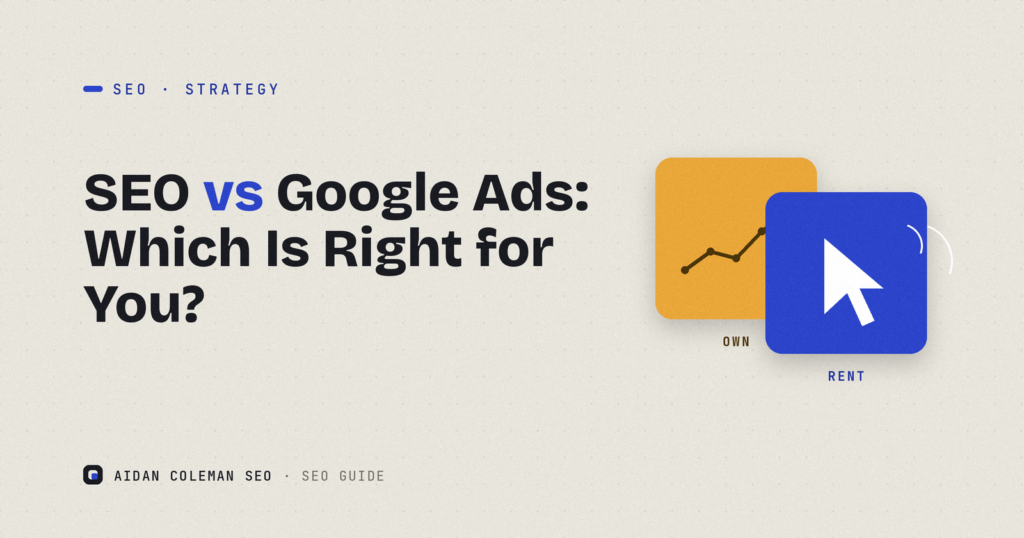
Here’s the difference in one line. Google Ads rents you a spot at the top of Google. SEO earns you one. With Google Ads, you pay for each click, and your spot vanishes the moment you stop paying. With SEO, you invest in your website over time, and the rankings you earn keep working long after the work is done. Here’s how the two compare at a glance:
| SEO | Google Ads | |
| Speed | Slow (months to build) | Fast (live in a day) |
| Cost model | Invest upfront, low ongoing cost | Pay per click, ongoing |
| What happens if you stop | Traffic fades slowly | Traffic stops at once |
| Control | Less direct | Highly controllable |
| Best for | Established businesses | Startups and new offers |
The rest of this guide unpacks what’s behind each of these.
What Is SEO?
SEO, or search engine optimisation, is the work of improving your website so it ranks higher in Google’s unpaid results. When you search for something and scroll past the ads, those organic listings are won through SEO. It covers a few things working together:
- Content that answers what people are searching for
- Technical health, so Google can crawl and understand your site
- Backlinks, which are links from other websites that vouch for yours
You don’t pay Google for these rankings. You earn them. That takes time and effort, but once you’re there, the traffic keeps coming without a price tag on every click.
What Are Google Ads?
Google Ads is paid advertising. You bid to appear at the very top of the results for the searches you choose, and you pay each time someone clicks your ad. The big draw is speed and control. A well-built campaign can put you in front of ready-to-buy searchers on day one. You decide the keywords, the budget, the locations, and the message, and you can change any of them in minutes. The catch is just as simple. The moment you switch the campaign off, your visibility disappears. You’re renting that top spot, and the rent never stops.
The Big Difference: Owning vs Renting Your Traffic
If you remember one thing from this guide, make it this. SEO builds an asset you own. Google Ads rents you traffic you don’t. Think of it like housing. Google Ads is renting. You get the keys straight away, but you pay every month, and the day you stop paying, you’re out. SEO is buying. It costs more upfront and takes longer to move into, but over time you build something that’s yours. This shows up most clearly when the spending stops:
- Switch off Google Ads, and the leads dry up the same day. When you stop paying for paid search, the traffic disappears immediately.
- Pause your SEO, and your rankings don’t vanish overnight. The pages and authority you’ve built keep drawing visitors for months.
That’s why so many business owners come to see SEO as a lead-generating asset rather than a bill. It keeps working even when you’re not actively feeding it.
Which One Gives a Better Return?
Over the long run, SEO usually wins on return, and often by a wide margin. The reason is compounding. With Google Ads, your costs rise with every click, and the returns stay roughly flat. Spend the same amount next month, get roughly the same traffic. With SEO, the work you do today keeps paying off tomorrow, so the return grows over time. The numbers back this up:
- An SEO research firm puts the median return on SEO at around 748% over three years.
- Leads tend to cost far less, too. Industry benchmarks from HubSpot put the cost of an organic search lead at roughly a third of a paid one.
None of this means Google Ads has poor returns. It means the two pay off on different timelines. Google Ads gives you a quick, steady return while you’re spending. SEO gives you a smaller return early that grows into a much larger one later. If you want to see how this is shifting as search changes, our latest AI SEO statistics round up the current numbers.
Why SEO Takes Time and Moves Around
SEO’s biggest weakness is patience. It is slow to start, and it doesn’t sit still. On timing, there’s no shortcut. Google has confirmed that SEO improvements generally take several months to take effect. For competitive industries, meaningful results can take closer to a year. You’re building authority, and that doesn’t happen in a fortnight. It’s also more volatile than paid ads. Your rankings can shift from week to week as Google updates its system, as competitors publish new content, and as search results get reshuffled. A position you hold today might move tomorrow, even if you’ve done nothing wrong. That mix of slow and shifting is exactly why measuring SEO properly matters. You can’t judge it on a single day’s rankings. If you want a clearer view of what to track, here’s our guide on how to measure your SEO over time.
Why SEO Works Best for Established Businesses
Here’s something many people get wrong. They assume older websites rank better just because they’re old. That’s a myth. Google’s John Mueller has said plainly that domain age helps nothing. So why do established businesses tend to do so well in organic search? Not because of the calendar, but because of the signals they’ve built up over years, and those signals are exactly what Google rewards. Older sites tend to rank well because over time they build the things Google actually cares about: backlinks, content depth, and brand demand. A few of these signals favour established brands in particular:
- Brand demand. When lots of people search for your business by name, Google reads that as a trust signal. Google’s systems use branded search as a quality signal, so more branded searches can lift your rankings on other terms too.
- Engagement signals. Google uses how people click and engage with your pages as part of its ranking, through systems like Navboost. Established brands tend to win more clicks and hold attention better.
- Reputation and reviews. A steady flow of genuine reviews builds trust, and it matters most in local search, where reputation feeds directly into how you show up.
Add it up, and SEO rewards businesses that already have an audience, a track record, and the patience to let it compound. If that’s you, SEO is likely where your best return sits.
Why Google Ads Works Best for Startups
For a new business, Google Ads often makes far more sense, and not just because it’s faster. The real advantage is feedback. A startup usually doesn’t know yet whether its offer lands, whether its prices work, or whether people will buy. Google Ads answers those questions quickly:
- Speed. You can be in front of buyers today, not in six months.
- Control. You choose exactly who sees your ad, where, and for how much.
- Scalability. If something works, you turn up the budget and get more of it.
- Fast learning. If your offer isn’t converting, you’ll see it in weeks and can fix it or move on.
That last point is the big one. With Google Ads, a weak offer shows up early, while you can still do something about it. With SEO, you might wait months to generate leads, only to learn the offer was the problem all along. And because SEO keeps working on its own, it won’t quietly switch off the way a paid campaign does. For a startup testing whether a business even works, that speed and control is worth a lot.
So, Which Should You Choose?
The honest answer depends on where your business is right now. Here’s a simple way to place yourself:
| Choose SEO if… | Choose Google Ads if… |
| You’re established with some brand recognition | You’re new and still proving your offer |
| You can wait months for results to build | You need leads this week |
| You want the lowest cost per lead over time | You want fast, predictable feedback |
| You’re building a long-term asset | You need to test, scale, or switch off quickly |
| Your customers research before they buy | You’re running a launch or limited-time offer |
Most businesses will lean one way based on their stage. A settled local business with reviews and repeat customers is built for SEO. A startup testing a new product is built for Google Ads.
Do You Have to Choose?
Not at all. The smartest approach often uses both, with each doing the job it’s best at. A common play looks like this. You start with Google Ads to bring in leads now and learn which keywords and offers actually convert. Then you take those proven winners and build SEO around them, turning short-term wins into lasting assets. Over time, as your rankings strengthen, you can lean less on paid clicks for the terms you’ve earned. If you’d rather build that skill in-house, our SEO coaching walks you through it step by step. And if you want a clear read on which mix fits your business, we’re happy to take a look and give you a straight answer. Call us