
TL;DR
- Market shift. ChatGPT sends roughly 78% of all AI chatbot referrals to websites, while Google’s search share has slipped below 90% for the first time in a decade. Search is no longer one destination. It is fragmenting across conversational assistants, and heading into 2027 your customers are splitting their questions between Google, ChatGPT, Gemini and Perplexity without thinking of any of it as “search” at all.
- The zero-click reality. 68.01% of US Google searches now end without a click, up from 60.45% in 2024. Only 276 of every 1,000 searches reach the open web, down from 374 two years earlier. Visibility inside the answer is the new priority, because for a growing share of queries the answer is the destination.
- Quality over volume. Clicks are scarcer but far more valuable. Semrush measured AI search visitors converting 4.4x better than traditional organic, and Adobe recorded AI-referred retail conversion flipping from 38% worse to 42% better in twelve months. Fewer visitors, better visitors.
- What actually gets cited. Ranking still helps, but the link between ranking and citation is breaking. Ahrefs found the share of AI Overview citations coming from top-10 pages fell from 76% to 38% in eight months. You can rank first and be invisible, or rank fortieth and be the answer.
- Authority wins, and mentions now beat links. Across 75,000 brands, Ahrefs found branded web mentions correlate 0.664 with AI Overview visibility against 0.218 for backlinks. Roughly three times the signal. Being talked about is the new link building.
- Before looking at the AI SEO stats, it helps to grasp how much AI now shapes search results heading into 2027. I have kept this to the numbers that matter for your business, and every one of them links back to the original research rather than to somebody else’s roundup.
- The bottom line: in 2027, success is less about ranking first and more about becoming the source the AI quotes. If your brand is not in the summary, you are invisible to a growing share of the market.
- Artificial intelligence has changed SEO permanently. Between Google’s AI Overviews, the newer AI Mode, and conversational engines like ChatGPT and Perplexity, search is increasingly driven by systems that summarise, cite and recommend rather than simply list. The ten blue links have not disappeared, but they are no longer where most journeys start or end.
- In many cases users get everything they need without clicking anything at all.
- So how do you get discovered and chosen in that environment? There is no secret formula, same as traditional SEO. But there is data. Below are 100 AI SEO statistics showing why it matters, where the real risk sits, and how to position your business to capture visibility instead of losing it heading into the new year.
- I have also included original research further down: my own measurement of how often AI platforms cite Australian websites, across more than two million citations.
- A note on sourcing. Every statistic names its source, its sample size and its date. Where a number comes from a small sample, a single company’s own traffic, or a vendor with something to sell, I say so in the line rather than hiding it. Where something is a forecast rather than a measurement, I say that too.
AI Search Adoption
-
ChatGPT passed 900 million weekly active users and 50 million paying subscribers.
OpenAI announced the figure in February 2026, more than double the 400 million it reported a year earlier. This level of reach makes ChatGPT a primary place your customers look for answers before they ever visit a website. A user base that size, built in barely three years, is faster adoption than any consumer product in history. -
ChatGPT handles roughly 2.5 billion prompts a day.
OpenAI gave that figure to Axios in July 2025, with about 330 million coming from US users. Two years earlier the number was closer to one billion a day. Every one of those prompts is a moment where a brand could be recommended, cited, or never mentioned at all. -
AI referral traffic grew 527% year on year.
Previsible reported the jump in August 2025, comparing the first five months of 2024 with the same period in 2025. That kind of acceleration is the hallmark of an interface shift rather than gradual adoption. It is the same curve shape mobile traffic drew fifteen years ago. -
AI referral traffic to US retail sites has grown 1,219% since October 2024.
Adobe has been tracking this across more than a trillion retail visits, and the climb has been steady rather than one big spike. Steady compounding is harder to dismiss as a fad than a single viral moment.
-
OpenAI serves more than 7 million ChatGPT workplace seats.
With enterprise seats up roughly 9x year on year according to the company. AI use has moved past pilot projects into real workflows at scale. When your buyers sit inside ChatGPT all day at work, asking it about vendors, suppliers and services is simply the next tab over.
-
Google’s AI Mode passed 1 billion monthly active users within a year of launch.
Google confirmed the milestone at I/O 2026, with queries more than doubling every quarter since. AI Mode removes traditional results entirely, so citation is the only route to visibility there. There is no position three to fall back on.
-
The average AI Mode query is three times longer than a traditional search,
and one in five AI Mode searches now uses voice, images or documents. That comes from Google’s own one-year usage report. Google is not treating AI Mode as an experiment. It is the template for where Search is heading, and it arrived in Australia in October 2025.
-
The Gemini app passed 1 billion monthly users in August 2026,
up from 400 million just fifteen months earlier on Google’s own numbers. It is built into Android, so it matters disproportionately for mobile. Many of those users never chose Gemini. It simply arrived on their phone, which is exactly what makes distribution-led adoption so hard to compete with.
-
Meta AI reports around 4 billion monthly active users
across WhatsApp, Instagram and Facebook. Social platforms are now AI-powered answer engines, though “monthly active” measured across an integrated suite is a generous definition and the figure is Meta’s own. Treat it as a signal of ambition rather than a precise measure of search behaviour.
-
Perplexity disclosed 780 million queries in a single month.
CEO Aravind Srinivas gave the May 2025 figure publicly, up from roughly 3,000 queries a day at the product’s 2022 launch. User counts for Perplexity swing wildly between trackers because the company does not report a standard global monthly-active-user figure, so treat any precise user number you see as an estimate. The query volume is the number the company actually stands behind.
-
Two in three people now use AI tools regularly.
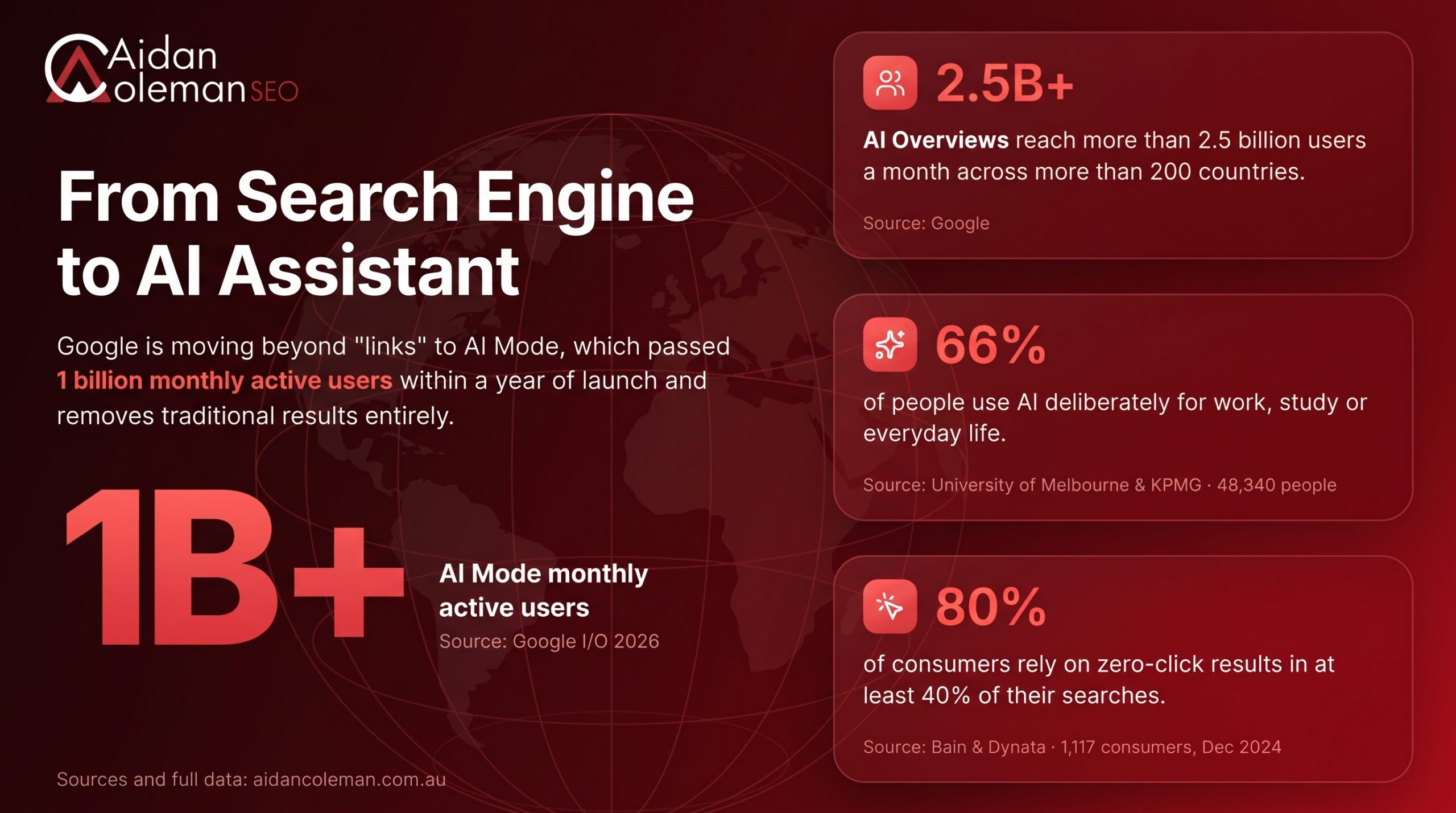
The University of Melbourne and KPMG put the question to 48,340 people across 47 countries over the summer of 2024-25, and 66% said they use AI deliberately for work, study or everyday life. This is not an early-adopter story any more. It is mainstream behaviour.
12. 68% of LLM users use the platforms to research and summarise information.
Bain’s consumer survey with Dynata of 1,117 people in December 2024 also found 48% use them for news and weather and 42% for shopping recommendations. These are precisely the jobs people used to give Google, which is why this list exists at all.
-
Google Search revenue grew 12% year on year to $63.4 billion in Q3 2026,
though growth has slowed from 19% at the start of the year. On the October earnings call Google said query growth was its highest in five years, admitted AI Mode queries monetise at a lower rate than classic search, and announced it is expanding ads in AI Mode to ten more countries, including Australia. Both things are true at once: AI is reshaping search, and Google is still getting paid.
-
Gartner predicted search volume would drop 25% by 2026, and it did not happen.
The forecast went out in February 2024, and Google has since held roughly 90% market share and grown revenue. It still gets quoted as though it already happened. Keep that track record in mind every time you read a forecast in this article, including Gartner’s next one further down.
-
AI referral traffic is still only about 1.08% of total sessions.
Conductor worked that out across 13,770 domains and 3.3 billion sessions, with ChatGPT responsible for 87.4% of it. Keep this number in your head while reading the rest. AI search is growing fast from a very small base, and anyone selling you panic is skipping this stat.
AI Overview Statistics
-
AI Overviews reach more than 2.5 billion users a month across more than 200 countries,
on Google’s own reporting. This is no longer a test inside Search. It is the default experience for nearly a third of humanity, and every summary it generates is built from someone’s content, with or without their knowledge.
-
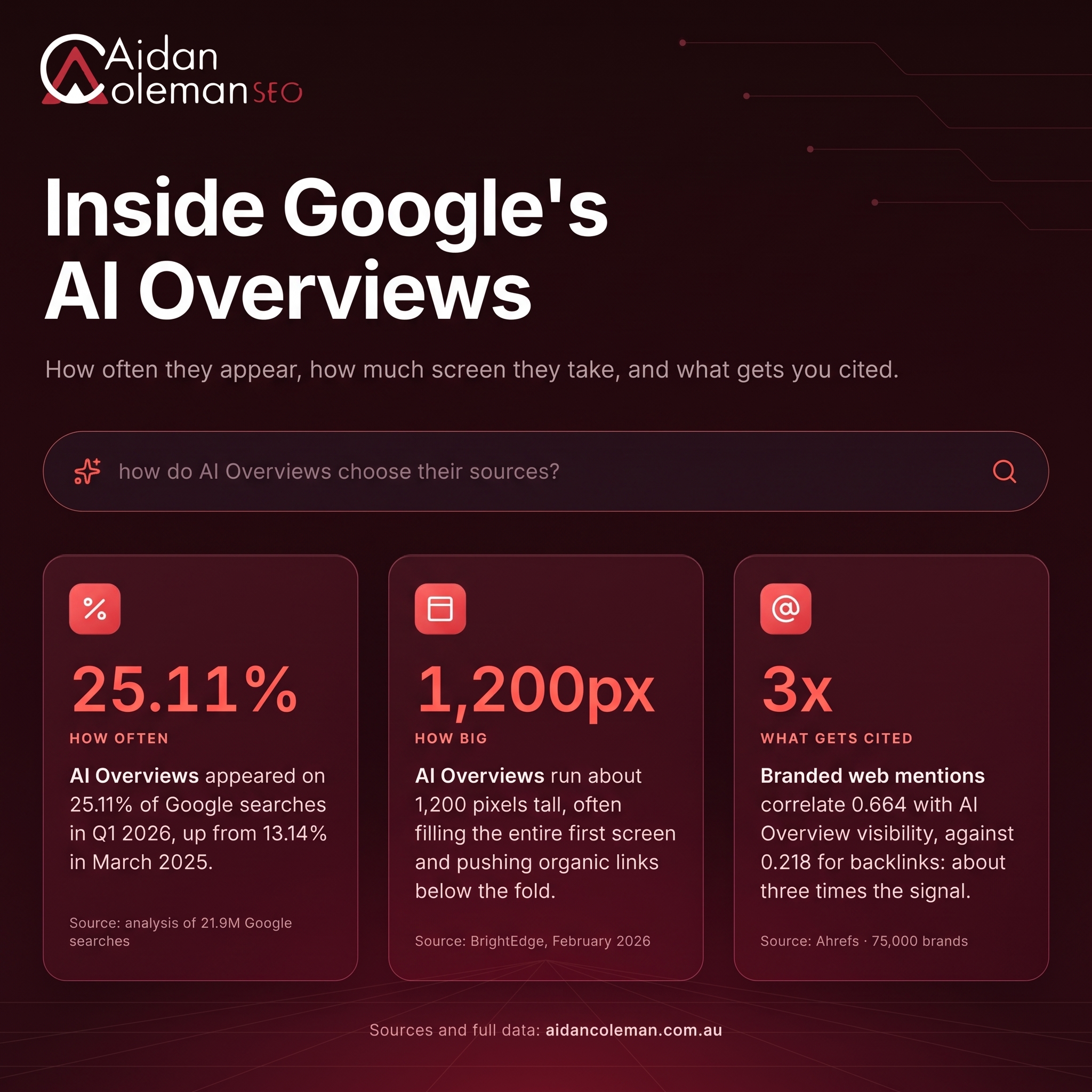
AI Overviews appeared on 25.11% of Google searches in Q1 2026.
That comes from an analysis of 21.9 million Google searches, up from 13.14% in March 2025. Prevalence nearly doubled in a year, and there is no sign Google intends to stop there.
-
Semrush saw prevalence peak at about 24.6% in July 2025, then fall to 15.69% by November
after Google recalibrated, across a sample of more than 10 million terms. Google adds AI Overviews, measures the reaction, pulls back, and adds again. Expect the same push-and-pull through 2027.
-
BrightEdge put the figure closer to 48% of tracked queries in early 2026,
a 58% year-on-year rise. Their keyword set skews commercial, which is exactly why their number runs higher than everyone else’s. The lesson is not that one tracker is wrong. It is that your exposure depends on which queries you live on.
-
The honest answer is a range of 20% to 50%.
Anyone quoting a single figure as the truth is quoting their own keyword set. Your real exposure depends on your industry, not the average, which is why the next two statistics matter more than any headline prevalence number.
-
Coverage by industry runs from 88% down to single digits.
BrightEdge tracked Healthcare at 88%, Education at 83%, B2B Technology at 82%, Restaurants at 78% and Insurance around 63% between February 2025 and February 2026. Education jumped from 18%, a 361% rise in a year. If you operate in one of these sectors, AI Overviews are not coming for your traffic. They already arrived.
-
E-commerce went the other way, falling from roughly 29% to 4%
over the same period, as Google pulled AI Overviews back from transactional queries. Google still wants shoppers clicking product listings and ads. For now, the checkout end of the journey remains protected, and that word “for now” is doing a lot of work.
-
About 18% of Google searches produced an AI summary, and 88% of those cited three or more sources.
Pew followed 68,879 searches from 900 US adults to find that. The typical summary ran 67 words. Sixty-seven words is all the room you get to be the answer, which is why front-loading matters so much further down this list.
-
AI Overview boxes peaked at roughly 1,340 pixels tall in December 2025, before Google trimmed them to about 1,200 pixels by February 2026.
That is BrightEdge’s tracking of the physical size of the answer box. Even at the reduced height, an AI Overview can fill the entire first screen on most devices, pushing every organic result below the fold before a user scrolls once.
-
Only 38% of AI Overview citations now come from pages ranking in the top 10, down from 76% in July 2025.
Ahrefs measured the collapse across 863,000 keywords and 4 million AI Overview URLs in March 2026. This is the most important correction in this article, because the old “76% comes from page one” figure is still quoted everywhere and it is more than a year out of date.The collapse coincides with Google making Gemini 3 the default model behind AI Overviews in January 2026, a switch one 100,000-keyword study found replaced roughly 42% of previously cited domains.
-
67.82% of pages cited in AI Overviews do not rank in Google’s top 10
for the query or its fan-out variations, according to Surfer’s analysis of 10,000 keywords in November 2025. Two-thirds of the sources Google’s AI trusts are pages traditional rank tracking would tell you are invisible.
-
Moz ran 40,000 queries through Google AI Mode and found 88% of citations came from pages outside the organic top 10.
A second dataset pointing the same way. When independent studies with different methodologies converge on the same conclusion, believe the conclusion.
-
Position-one pages are still cited 3.5 times more often than pages outside the top 20.
That comes from picking apart 548,534 retrieved pages across 15,000 prompts. Ranking has not stopped mattering. It has stopped being sufficient. Think of a top ranking as the entry ticket, not the prize.
-
ChatGPT cites only 15% of the pages it retrieves.
The other 85% get read, weighed up and thrown away before you ever see them. Being retrieved is an audition, not a booking. Your page gets one read to prove it deserves the citation.
-
89.6% of prompts trigger two or more fan-out queries, and 32.9% of cited pages are found only through those fan-outs.
Stranger still, 95% of those fan-out queries had no measurable search volume at all, so they sit outside every keyword tool you own. You can be cited for a question you never targeted, and you can lose to a competitor targeting questions you have never seen.
-
Roughly 44% of LLM citations come from the first 30% of a page,
across several 2025 and 2026 analyses. Front-loading your answer matters more than burying it after the preamble. The thousand-word wind-up before the point is now actively costing you citations.
-
YouTube accounts for roughly 23.3% of all AI Overview citations, with Wikipedia at 18.4%.
That comes from Surfer’s analysis of 46 million citations. Two platforms take more than four in ten citations between them, which tells you how much AI systems lean on video and encyclopaedic content, and why a YouTube presence has quietly become an AI SEO asset. -
The average AI Overview cites around eight sources.
Washington University researchers measured 61,212 citations across 55,393 searches in March and April 2026, in the broadest independent audit of AI Overviews published so far. Eight slots per answer is the whole market for visibility on that query. It is a far smaller game than ten blue links, and the competition for each slot is correspondingly fiercer.
-
AI Overview content changes around 70% of the time for the same query.
Ahrefs found roughly 45.5% of citations get replaced when the answer regenerates, which makes AI visibility far less stable than rankings. A citation today is not a citation tomorrow, which is why one-off screenshots prove nothing and ongoing tracking is the only honest measure.
-
About half of AI Overviews contain at least one unsupported claim,
on Oumi’s analysis using its HallOumi detection model in late 2025 and early 2026. Hallucination rates vary hugely by model and query type, so treat the figure as indicative. For a local business it is not abstract though: a wrong phone number, stale opening hours or an outdated price can cost you the job without you ever seeing it happen.
AI Search Shifts
-
68.01% of US Google searches ended without a click in early 2026.
Working from Similarweb’s clickstream panel, SparkToro found only 276 of every 1,000 searches now reach the open web, down from 374 two years earlier. The figure was 60.45% in 2024. The open web is losing roughly a hundred visits per thousand searches every two years, and nothing in the data suggests the trend reverses in 2027.
-
80% of consumers now rely on zero-click results in at least 40% of their searches.
Bain’s survey of 1,117 consumers with Dynata in December 2024 estimated this is reducing organic web traffic by 15% to 25%. The behaviour is not confined to one demographic or one query type. Reading the answer on the results page is simply how people search now.
-
Even self-described AI sceptics mostly do not click.
The same Bain research found about half of people who say they are sceptical of generative AI still report that most of their queries get answered on the search page without a click. Distrust of AI, it turns out, does not translate into clicking your website instead.
-
Google AI Mode produces a 93% zero-click rate,
on one analysis from September 2025. That is a single vendor’s data, but the direction is hardly surprising when AI Mode replaces the results page entirely. As AI Mode usage grows through 2027, that 93% figure is the future being previewed.
-
Position-one click-through rate fell 34.5% when an AI Overview appeared.
Ahrefs checked it against 300,000 keywords in April 2025, using real Search Console data rather than estimates. Earning the top spot and losing a third of its value overnight is the experience thousands of sites have quietly lived through.
-
Ahrefs re-ran the same study on December 2025 data and the drop had worsened to 58%,
comparing click-through rates before AI Overviews existed with those at the end of 2025. The decline did not plateau after launch. It deepened as Google expanded coverage and users learned to trust the summary.
-
A randomised experiment found AI Overviews caused organic clicks to fall 39.8%.
The field experiment ran on 1,065 desktop Chrome users and was published on SSRN in April 2026, giving the first causal rather than correlational evidence. Every other study in this section observes a correlation. This one manipulated what users saw and measured what changed, which makes it the strongest single piece of evidence that the AI Overview itself, not query mix or seasonality, is what suppresses clicks.
-
Organic click-through rate on AI Overview queries fell 61%, from 1.76% to 0.61%.
Seer followed 3,119 queries across 42 organisations and 25.1 million impressions to get there. Paid click-through rate fell even further, down 68%. Advertisers are not immune to the answer box. Nobody is.
-
Brands cited inside the AI Overview earned 35% more organic clicks and 91% more paid clicks
than those left out, in the same Seer dataset. Being the source is worth real traffic. The citation is not a vanity metric. It is the difference between participating in the query and watching it from outside.
-
In early 2026 the decline reversed, with organic CTR rebounding 85%.
The April 2026 update covered 53 brands, 5.47 million queries and 2.43 billion impressions, and found click-through rate climbing off a 1.3% floor in December 2025 to 2.4% by February. This is the most current data available and almost nobody is quoting it, because “things got slightly better” does not go viral the way collapse does.
-
Being cited now delivers 120% more organic clicks per impression than not being cited, but still 38% fewer than having no AI Overview at all.
Seer’s per-million breakdown is the clearest way to see it: about 33,500 clicks with no AI Overview, 20,743 if you are cited, 9,445 if an AI Overview appears and you are not. The hierarchy for 2027 is simple: no AI Overview beats being cited, and being cited beats everything else by a mile.
-
Users clicked a traditional result in just 8% of searches with an AI summary, against 15% without.
This one came from watching what people actually did rather than reading aggregate Search Console data, which makes it the most grounded number in this section. Google publicly disputed the methodology, which tells you how much the finding stung.
-
Only 1% of users clicked a link inside the AI Overview itself.
Pew also found people were more likely to end their browsing session entirely after seeing a summary, 26% against 16%. The citations inside the box are read far more than they are clicked, which is why their value is influence and brand recall rather than referral traffic.
-
Amsive found a much milder average decline of 15.49%,
across 700,000 keywords, and branded queries actually gained 18.68% click-through rate. When an AI Overview stacks on top of a featured snippet, though, the drop reached 37.04%. Averages hide the pain. Your mix of branded, commercial and informational queries decides which end of the range you live on.
-
In German results, position-one CTR fell from 27% to 11%,
a 59% collapse, on SISTRIX’s analysis of more than 100 million keywords. This is not a US-only phenomenon, and there is no reason to assume Australia is spared just because nobody has published an equivalent local study yet.
Why these studies disagree so violently
The range runs from Amsive’s 15.49% to Ahrefs’ 58%, which looks like chaos until you check what each one measured.
Ahrefs isolated informational queries, where AI Overviews appear on more than 99% of results. Amsive averaged across all query types including branded and commercial ones, where AI Overviews are rarer and sometimes helpful. Pew measured real human behaviour rather than aggregate Search Console data. Seer tracked one cohort over time, which is why it caught a rebound everyone else missed. The SSRN experiment controlled what users saw, which is why it could claim causation.
They are not contradicting each other. They are answering different questions. The direction is unanimous.
-
AI search visitors convert at 4.4 times the rate of traditional organic visitors.
Semrush went through more than 500 high-value topics and published on 21 July 2025, a date half the internet gets wrong by a month. A visitor who arrives from an AI recommendation has already been pitched, compared and reassured before they land. The AI did your top-of-funnel for you.
-
Ahrefs found AI visitors made up 0.5% of its traffic but drove 12.1% of signups,
a 23x conversion multiplier. Their own analytics also showed those visitors spending 86 seconds on site against 78 for search visitors, while viewing fewer pages and bouncing slightly more. It is one SaaS company’s own traffic, so read it as directional, but they published the working. The behaviour makes sense: AI visitors arrive having done the research, check one thing, then act or leave.
-
AI-referred retail conversion flipped from 38% worse to 42% better in twelve months.
Adobe caught the swing across more than a trillion US retail visits between March 2025 and March 2026. By July 2026 the gap had widened to 60% better, an eleventh consecutive month of AI traffic outperforming. Early AI traffic was tyre-kickers. Current AI traffic is buyers. By September 2026 AI-referred visits were converting 90% better than non-AI traffic and generating 83% more revenue per visit, and Adobe expects the advantage to widen further through the holiday season. Early AI traffic was tyre-kickers. Current AI traffic is buyers.
-
AI-referred retail traffic grew 393% year on year in Q1 2026,
peaking at 1,151% in December during the holiday season. Adobe found those visitors generated 37% more revenue per visit and spent 48% longer on site. People are not just researching through AI any more. They are shopping through it, and the December peak says they trust it with their Christmas spending.
-
A counter-finding worth knowing: Amsive’s paired analysis across 54 sites found LLM traffic did not convert significantly differently from organic overall,
with a p-value of 0.794. B2B showed a modest edge at 2.17% against 1.16%. This is the strongest challenge to the conversion-premium narrative, and both it and the 4.4x figure are real. Use them together, and test the premium on your own analytics before you budget around it.
-
Nearly 90% of ChatGPT citations come from pages ranking at position 21 or below
for the related query, in the same piece of research. It also found 50% of links in ChatGPT responses point to business and service websites rather than publishers. ChatGPT is not just reading the news. It is recommending businesses, possibly yours, possibly your competitor’s.
-
Branded web mentions correlate 0.664 with AI Overview visibility, against 0.218 for backlinks.
Ahrefs ran the correlations across 75,000 brands and found brand anchors at 0.527, branded search volume at 0.392 and content volume at just 0.194. Around 26% of the brands studied had no mentions at all, which means a quarter of brands are starting this race from zero.
-
YouTube mentions were the single strongest signal of all, at roughly 0.737.
Ahrefs’ December 2025 follow-up extended the analysis to ChatGPT and AI Mode and the pattern held. Correlation is not causation here, since brands that earn mentions also tend to be brands that invest in everything else. But it is why link building now has to be thought about as brand building rather than link counting.
-
Ahrefs found 67.8% of all non-cited URLs came from Reddit.
Across 1.4 million prompts, ChatGPT read Reddit constantly for context but only cited it about 1.93% of the time. The model treats Reddit as background reading, not as a source worth naming, which is a useful distinction when someone tells you Reddit is all that matters.
-
Only 16% of brands systematically track AI search performance.
McKinsey surveyed around 30 Fortune 500 CMOs in September 2025 to get that, which is a small sample. GoodFirms separately found only 14% of marketers use AI citation tracking, despite 43% calling AI search optimisation a core 2026 strategy. The gap between talking about AI search and measuring it is where the competitive advantage currently sits.
AI Search Engine Market Share Statistics for 2027
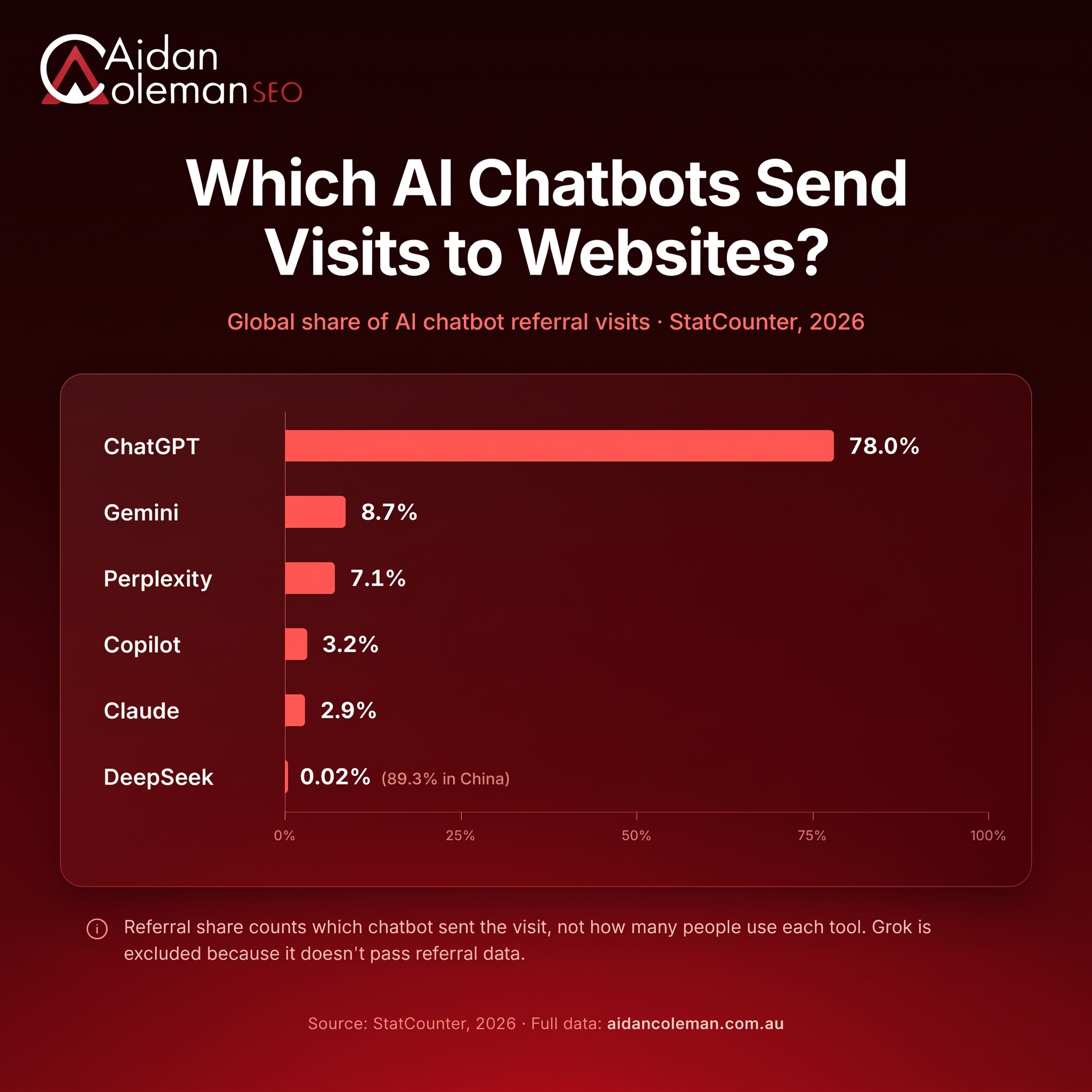
The figures below come from StatCounter, which tracks which chatbots actually send visits to websites, based on more than 3.8 billion monthly page views across 1.5 million sites.
One important clarification, because this gets misreported constantly. StatCounter measures referral share, meaning which chatbot sent the visit. It is not a measure of how many people use each tool. Grok is excluded entirely because it does not pass referral data in its header.
-
ChatGPT: roughly 78% of AI chatbot referrals.
Despite a growing field of rivals, OpenAI’s flagship remains the gatekeeper of generative search. Holding over three-quarters of referrals, it is where the vast majority of AI-driven brand discovery happens. A ChatGPT citation is not a bonus metric. It is the core one, and it will stay the core one through 2027 barring something dramatic.
-
Google Gemini: around 8.7%.
Gemini’s strength is native integration across Android, Workspace and Chrome, which makes it the fastest-growing threat to ChatGPT and the bridge between traditional Google Search and conversational AI. If any platform closes the gap in 2027, the smart money is on the one pre-installed on three billion devices.
-
Perplexity: around 7.1%.
Built entirely around citations and real-time indexing, Perplexity is the most link-friendly AI tool, and its users are historically more likely to click through to sources. Data-backed content performs disproportionately well here, which makes it the platform where original research earns its keep fastest.
-
Microsoft Copilot: around 3.2%.
Modest share, but its users sit inside Microsoft 365 all day. That makes it a critical platform for B2B providers reaching decision makers during the working day, when purchase research actually happens.
-
Claude: around 2.9%.
Anthropic’s model is used heavily for long-form analysis and technical work. For expertise-heavy sectors like legal, medical and complex technical services, a Claude citation is a strong trust signal from an audience that reads carefully.
-
DeepSeek: around 0.02% globally, but 89.3% in China.
Tiny in most markets, dominant in one, as was clear when the dataset first launched. Worth watching if you have any Asian market exposure, and a reminder that “the AI market” is really several regional markets wearing one name.
-
In Australia, the referral mix looks different: ChatGPT holds 67.7%, with Microsoft Copilot second at 14.2%.
StatCounter’s Australian data for June 2026 put Gemini at 7%, Claude at 6.1% and Perplexity at 5.1%. Copilot punches well above its global weight here, likely because of how deeply Microsoft 365 sits inside Australian workplaces. If you sell B2B in Australia, Copilot visibility deserves more attention than the global averages suggest.
-
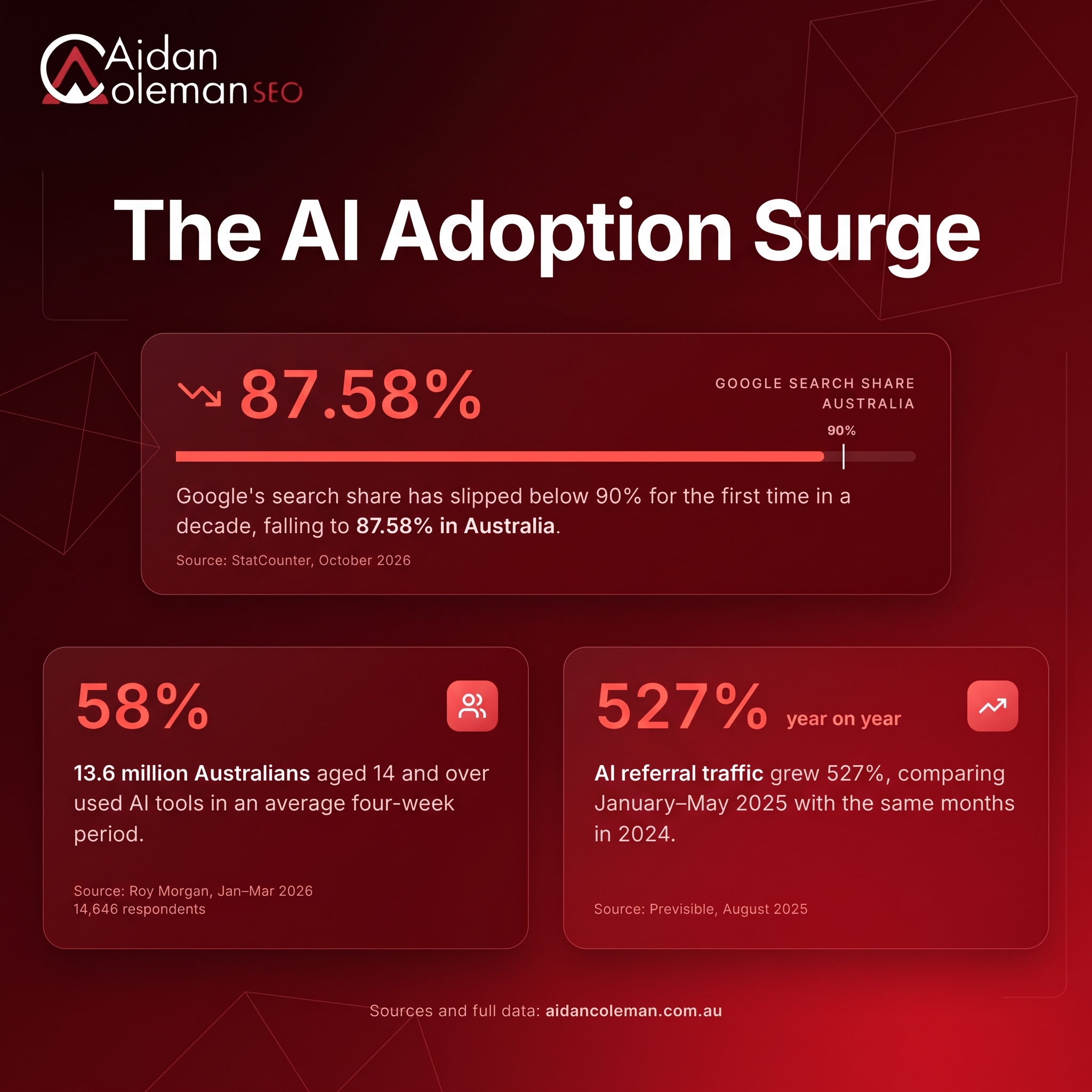
Google’s search share has slipped below 90% for the first time in a decade.
In Australia it sat at 87.58% in October 2026, with Bing on 9.4% and Yahoo on 1.6%. A couple of points of share sounds small until you remember each point represents tens of millions of searches a day.
-
A caution on all market share figures.
StatCounter’s referral share is one measure. Similarweb’s analysis of generative AI web traffic put ChatGPT’s share at roughly 56.7% by March 2026, down from 86.7% in January 2025. Both are real. They count different things, and neither is “the” market share. Whenever you see a market share claim in 2027, your first question should be: share of what, measured how?
Our Own Data: Who AI Actually Cites in Australia
Everything above is published research. This section is mine.
I measured how often AI platforms cite Australian websites, pulling citation counts across ChatGPT, Google AI Overviews, Google AI Mode, Gemini, Perplexity and Copilot, filtered to Australian responses. 2,126,859 citations across 1,288,802 cited pages.
| Domain | AI citations | Cited pages |
| reddit.com | 1,938,398 | 1,198,179 |
| productreview.com.au | 91,447 | 34,175 |
| business.gov.au | 34,566 | 29,268 |
| realestate.com.au | 30,143 | 17,780 |
| hipages.com.au | 19,396 | 2,727 |
| yellowpages.com.au | 8,450 | 4,024 |
| healthengine.com.au | 2,586 | 1,960 |
| serviceseeking.com.au | 1,136 | 332 |
| oneflare.com.au | 737 | 357 |
-
Reddit was cited 1,938,398 times in Australian AI responses, against 188,461 for all eight Australian domains combined.
A US forum out-cites every major Australian directory by 10.3 to 1. When an Australian asks an AI who to hire, what to buy or where to go, the answer is being assembled largely from conversations happening on an American platform.
-
ProductReview.com.au is the most-cited Australian domain at 91,447 citations,
ahead of business.gov.au and realestate.com.au. Review platforms, not directories, are Australia’s AI citation engine, which makes your review profile an AI visibility asset rather than just a conversion one. Every review a customer leaves is now potential training material for the answer an AI gives about you.
-
Two competitors in the same category sit 26x apart.
hipages earned 19,396 citations. Oneflare earned 737. Being in the right category does not make you a source. The platforms are not citing categories. They are citing specific pages that answer specific questions well.
-
Depth beats breadth.
hipages earns 7.1 citations per cited page against business.gov.au’s 1.2. A small number of genuinely useful pages gets quoted over and over. For a business deciding where to spend 2027’s content budget, this is the argument for ten excellent pages over a hundred thin ones.
-
The platform that cites you depends on what kind of site you are.
Oneflare draws 58.4% of its citations from Perplexity. business.gov.au draws 71.4% from ChatGPT. Reddit, the most-cited domain of all, draws just 5% from ChatGPT. There is no single “AI visibility” to optimise for. There are six platforms with six different appetites.
| Domain | ChatGPT | AI Overviews | AI Mode | Gemini | Perplexity | Copilot |
| reddit.com | 5.0% | 37.7% | 17.2% | 8.8% | 31.2% | 0.2% |
| business.gov.au | 71.4% | 6.5% | 4.0% | 2.7% | 9.8% | 5.5% |
| oneflare.com.au | 28.7% | 8.6% | 1.5% | 2.1% | 58.4% | 0.7% |
| yellowpages.com.au | 22.5% | 16.8% | 5.4% | 6.5% | 36.6% | 12.2% |
| productreview.com.au | 28.2% | 15.9% | 6.2% | 10.9% | 25.8% | 13.0% |
| hipages.com.au | 22.1% | 27.3% | 19.3% | 8.8% | 15.8% | 6.7% |
| realestate.com.au | 29.2% | 26.6% | 17.5% | 8.7% | 11.6% | 6.4% |
| healthengine.com.au | 23.3% | 23.7% | 12.3% | 15.0% | 20.2% | 5.6% |
| serviceseeking.com.au | 22.5% | 15.5% | 13.5% | 7.3% | 14.8% | 26.3% |
-
Across the eight Australian domains, ChatGPT accounted for 33.9% of citations,
then Perplexity at 21.0%, AI Overviews at 17.1%, Copilot at 10.3%, Gemini at 8.9% and AI Mode at 8.8%. Note how far that sits from StatCounter’s 78% referral share. Referrals and citations are not the same thing, and if you only check ChatGPT you are auditing a third of the picture.
Australian AI Search Statistics
Nearly every AI SEO statistics article you will read is US data. Here is what we actually know about Australia.
-
13.6 million Australians, or 58% of those aged 14 and over, used AI tools in an average four-week period.
Roy Morgan asked 14,646 people between January and March 2026. ChatGPT led with 10.5 million users, Gemini 5 million and Copilot 4 million. More than half the country is now using these tools regularly, which means more than half your market is.
-
12% of Australians now name AI tools as their main way of finding information online, up from 5% a year earlier.
That is Telsyte’s Australian AI study for 2026. One in eight Australians treating AI as their default front door to the internet, and the figure more than doubling in twelve months, is the local behaviour shift this whole article has been building to.
-
49% of Australians used generative AI in the previous year, up from 38% in 2023,
in a Google and Ipsos survey of around 1,000 Australians conducted in late 2024. That is a small sample, but it points the same direction as the Roy Morgan data from a larger one.
-
Australian SME AI adoption reached 44% in February 2026.
The National AI Centre tracks this every month with at least 400 businesses per wave, and has it up from roughly 37% a year earlier. Your competitors are adopting these tools whether or not you are.
-
Around 12% of Australian businesses used AI in 2024-25, up from 1% in 2021-22.
The Bureau of Statistics asked nearly 7,000 businesses and released the numbers in June 2026. The gap with the 44% above exists because the two measure different populations and thresholds, not because one is wrong. A twelvefold rise in three years is the number worth keeping.
-
AI chatbots still account for just 0.39% of Australian web traffic.
StatCounter’s May 2026 data put search at 90.72% of Australian referral traffic and social at 8.89%. This is the Australian version of statistic 15: the behaviour is shifting fast, but the traffic mix has barely started moving. You are early, not late.
-
Across 115 Australian businesses and 24.8 million sessions, median AI-referred traffic grew roughly 1,200% year on year, and 88.5% of sites had already received some AI traffic.
That comes from Optimising’s Australian AI Traffic Study, a vendor’s own client data, so read it as directional rather than a census. Small base, steep trajectory, almost universal reach. The pattern matches the US data point for point.
-
AI Overviews launched in Australia on 31 October 2024,
announced quietly on Google’s Australian blog, with AI Mode following a year later in October 2025. Australia runs roughly six to twelve months behind the US rollout, which means the US statistics in this article are less a foreign curiosity and more a preview.
-
Only 36% of Australians are willing to trust AI systems, against a global average of 46%.
That same global study found 46% of Australians believe the risks outweigh the benefits, just 24% feel able to use AI tools effectively, and 77% say regulation is needed.
-
Nobody has publicly measured how often AI Overviews appear in Australian search results.
Every prevalence figure you will see quoted is a US sample. If someone tells you “X% of Australian searches show AI Overviews,” ask them for the source. As of this update, there still is not one.
Australians use AI heavily and trust it less than almost anyone. That combination matters, because most people are still checking your website, your reviews and your Google listing after the AI names you.
AI search and local businesses
-
Informational “near me” queries showed an AI Overview 76.9% of the time
across 188,606 impressions measured in April 2026. If your local strategy leans on “how do I” and “what is the best way to” content, three-quarters of those searches now open with an AI answer.
-
But transactional queries showed AI Overviews only around 5% of the time, and commercial queries around 8%.
The half of local search where people actually book is still relatively protected. Google is keeping the money queries clean, for the same reason it pulled AI Overviews back from e-commerce.
-
Google Business Profile signals account for roughly 32% of local pack influence, and review signals about 20%,
up from 16% in 2023. Whitespark’s Local Search Ranking Factors survey of around 47 local SEO experts is expert opinion rather than controlled testing, so treat it as an informed estimate rather than measurement.
Put those three together and your local SEO and Google Business Profile are doing double duty: winning the searches AI has not taken, and feeding the answers where it has.
How Marketers Are Responding: Budgets, Buyers and What Comes Next
This section is new for the 2027 update. The statistics above describe what AI is doing to search. These describe what the industry is doing about it, and most of them come from vendor or practitioner surveys, so I have named the sample and the seller in every line.
-
69% of search professionals now have budget allocated for AI search optimisation, up from 38% in 2025.
The SEOFOMO State of AI Search Optimization survey, published in September 2026, also found 98% have had a client, manager or decision maker ask about AI search visibility, up from 91% the year before. The budget nearly doubled in a year. The questions are already universal.
-
35% of those same professionals cannot say what AI search contributes to revenue at all, and 46% put it at 0% to 5%.
Same SEOFOMO survey. Teams are being funded to do work whose commercial impact most of them cannot yet measure, which is a hard position from which to defend next year’s budget. If you can measure it and your competitors cannot, that is an advantage.
-
Marketers put an average of 24% of their search or content budgets toward AI search visibility, yet 81% still call the work SEO.
Fractl’s survey, reported through Search Engine Land and Digiday in mid-2026, found 82% have allocated at least some budget and 43% spend more than 20% of it there. A quarter of the budget has quietly moved, even while the label on the invoice stayed the same.
-
Only 22% of marketers say their SEO and AI search efforts are fully integrated, and just 9% can measure all the metrics that matter.
That is Semrush’s June 2026 research, from a vendor that sells the measurement tools, so weigh it accordingly. Even discounted, the shape rings true: adoption is racing ahead of integration and measurement.
-
63% of marketers say their company invests nothing in GEO.
Centerfield surveyed 878 US marketers in 2025, reported through Search Engine Land, and found GEO averaging 9% of marketing resources against 24% for SEO and 36% for social, with 93% citing barriers, led by budget at 40%. Yes, this sits in tension with Fractl’s 24% figure. Different samples, different definitions, same lesson as the CTR studies: the range is the finding.
-
94% of enterprise executives responsible for AEO, GEO or SEO plan to increase their investment in it.
Conductor surveyed more than 250 senior executives and digital decision makers at enterprise organisations in January 2026, and AI search optimisation ranked as their top marketing priority for the year. Conductor sells an AEO platform, so the sample skews toward believers, but the enterprise end of the market has clearly decided.
-
86.6% of marketing leaders are prioritising AI search, but only 23.2% feel confident measuring its impact.
AirOps’ Marketing Leaders Reality Index surveyed 307 leaders in July and August 2026. The same survey found 75.4% carrying higher pipeline or revenue targets while only 43% received any budget increase. Priority without measurement and targets without budget: that is the state of the discipline going into 2027.
-
22% of CMOs now start vendor research in an AI answer engine, ahead of the 16% who start with Google or another search engine.
Profound published that in July 2026. It is a vendor survey, but the direction matters more than the decimal: for the most senior buyers, AI has already overtaken search as the first stop.
-
Half of B2B software buyers start their search in an AI chatbot, and G2 listed 248 AEO products by April 2026.
Both figures are G2’s own 2026 data. Two years ago the AEO software category did not exist. Now there are two hundred and forty-eight tools fighting to sell you visibility in it, which tells you where the industry believes the money is going.
-
92% of surveyed B2B organisations are already experimenting with or operationalising GEO.
The 2026 State of Generative Engine Optimization in B2B Marketing study from GNW Consulting and Demand Metric surveyed 225 B2B marketing and revenue leaders. It also found 88% of SEO agencies claim to offer GEO services, while more than a third describe those offerings as loosely defined. Plenty of agencies are selling AI SEO. Fewer can tell you what is actually in the box.
-
52% of B2B marketers rate AI answer engines as their most effective distribution channel, against 29% for organic search.
10Fold’s survey, reported by Digiday in August 2026. Self-reported effectiveness is a soft measure, and the sample is marketers rather than their analytics, so treat it as sentiment. But sentiment is where budgets start.
-
Gartner forecasts that brands’ organic search traffic will fall by 50% or more by 2028 as consumers embrace generative AI search.
This comes from the same February 2024 release as the 25%-by-2026 prediction that already missed, so quote it as a forecast with that track record attached, not as a fact. It earns the final slot anyway, because even if Gartner is half wrong again, a 25% decline by 2028 would still be the biggest structural change to organic traffic in the history of the channel. Plan for the direction, not the decimal.
What Metrics Measure Success in AI Search Engines?
Rankings and sessions do not capture AI performance, because most AI influence never produces a click. Five metrics do.
Citation count, tracked per platform. How often AI platforms reference your domain and across how many unique pages. This is the closest thing AI search has to a ranking. Split it by platform rather than blending it, for the reasons in stat 74: the platform that cites you depends on what kind of site you are, and a blended number hides exactly the gaps you need to see.
Share of voice against competitors. Your citations as a proportion of your category’s total. Absolute numbers mislead. Oneflare’s 737 sounds fine until you learn hipages has 19,396. The question is never “are we cited”. It is “are we cited as often as the business your customer will hire instead”.
Prompt coverage. The percentage of the questions your customers actually ask where your business appears in the answer. More useful than raw counts because it is tied to real buying questions, and given that 95% of fan-out queries have no search volume, keyword tools will not find these for you. Build the question list from sales calls, support tickets and reviews, not from a keyword tool.
AI referral traffic and its conversion rate, tracked separately. Most GA4 setups bury ChatGPT and Perplexity referrals in “Other” or misattribute them as direct. Given the conversion premium, your highest-intent traffic may be invisible in your own reporting, and stat 90 shows most of the industry is in exactly that position. More on how to measure AI SEO performance.
Sentiment and factual accuracy. With roughly half of AI Overviews containing an unsupported claim, checking what the machine actually says about you is now part of the job. The audit is simple: ask each platform the questions your customers ask, and read the answers as a sceptical buyer would.
What does not count: a screenshot of ChatGPT naming your business once. With citations changing around 70% of the time on regeneration, one good result is an anecdote. Same reason rank tracking alone was never enough.
Four AI SEO Statistics You Should Stop Repeating in 2027
This section exists because I got tired of tracing numbers back to nothing. Heading into a new year, these four will be copy-pasted into a thousand fresh roundups. Here is why they should not be in yours.
“76% of AI Overview citations come from top-10 pages.” True in July 2025. By March 2026 Ahrefs measured it at 38%, and Moz found 88% of AI Mode citations came from outside the top 10. If you are still quoting 76%, you are describing a search engine that no longer exists, and any strategy built on it is a strategy for 2025.
“Search volume dropped 25% in 2026.” A Gartner forecast from February 2024 that predicted a drop by 2026. Google grew search revenue 19% instead. Quote it as a prediction that missed, and apply the same scepticism to Gartner’s 50%-by-2028 forecast in stat 100.
“ChatGPT has 78% of AI search usage.” StatCounter measures referral share, not usage. It counts which chatbot sent a visit to a website, and it excludes Grok entirely. Similarweb’s traffic-based measure puts ChatGPT closer to 57%, and in my own Australian citation data it accounted for 33.9%. Three real numbers, three different questions. Say which one you mean.
“AI Overviews cut clicks by 58% and it keeps getting worse.” Ahrefs did measure 58%, but Seer’s April 2026 data shows CTR rebounding 85% off its December 2025 floor. The collapse narrative is more than a year out of date. The honest 2027 framing is: clicks fell hard, then partially recovered, and being cited is what separates the two outcomes.
From Statistics to Strategy
Here is where I tell most business owners to start in 2027.
Keep your content fresh and easy to parse, so engines can lift clean sections into their answers. Front-load the answer, since around 44% of citations come from the first third of a page. If your best point sits below your worst preamble, swap them.
Use the formats AI prefers. Structured, clearly segmented content gets extracted more readily. Lists, tables and direct question-and-answer blocks all help a model find a quotable unit. With the average AI Overview citing only a handful of sources , you are competing for a handful of slots, and the page that hands the model a clean, liftable answer wins them.
Make your expertise visible with expert quotes, original data and clear proof points. Original statistics are among the most citable things you can publish, which is precisely why this article contains my own. You do not need two million data points. One honest measurement of your own niche beats a recycled roundup.
Build mentions, not just links. A 0.664 correlation against 0.218 is not a subtle difference, and YouTube mentions at 0.737 were stronger still. Being talked about now matters more than being linked to, and with YouTube also taking 23.3% of AI Overview citations, video is pulling double duty as both a mention source and a citation source.
Be present in your community and online conversations. Reddit out-cites every Australian directory 10 to 1 in my data, and ProductReview out-cites every listing site. Community presence and review platforms feed directly into what AI tells people about you. The conversations are happening either way. The only question is whether your business is in them.
Check more than ChatGPT. It was 33.9% of citations across the Australian domains I measured, and under 6% for one of them. An audit that only opens one app is an audit of a third of the market.
Start measuring before your competitors do. 69% of search teams now have AI search budget, but 35% cannot connect it to revenue and only around a quarter of leaders feel confident measuring impact. Fix your GA4 attribution, track citations per platform, and you will be answering questions most of the industry is still guessing at.
Keep it in proportion. At 1.08% of sessions globally, and 0.39% of Australian web traffic, AI is not yet a channel you can build a business on. It is one you make sure you are present in before it matters. Traditional SEO still pays the bills, and the AI layer sits on top of the fundamentals rather than replacing them.
At the end of the day this is not about chasing algorithms. It is about showing up where your customers are looking, and more of them are looking at AI every month. Take small, practical steps today and you will be in the right place through 2027 while your competitors are still catching up.
Methodology
My own citation data was pulled from Ahrefs in August 2026, using its AI response citation data filtered to Australian responses, across ChatGPT, Google AI Overviews, Google AI Mode, Gemini, Perplexity and Copilot. Nine domains were measured at subdomain scope, totalling 2,126,859 citations across 1,288,802 cited pages. Platform percentages are each domain’s share across those six platforms and exclude Grok, which Ahrefs reports separately. These are citation counts, not traffic: a citation means a platform used the page as a source, not that anyone clicked. Domain selection was judgement-based and is not a census.
This 2027 edition expands the article from 75 to 100 statistics. The 25 additions come from named studies published through 2026, including Bain, SEOFOMO, Fractl, Semrush, Centerfield, Conductor, AirOps, Profound, G2, GNW Consulting and Demand Metric, 10Fold, Surfer, Authoritas, BrightEdge, Telsyte, StatCounter and a randomised field experiment published on SSRN. The same sourcing rules apply to them as to everything else here.
Third-party statistics name their source, sample size and date in the line, and link to the original research wherever a verified URL exists. Where a commonly-repeated figure could not be traced to a primary source, it is flagged as unmeasured rather than repeated.
Every figure here is a snapshot of a field that moves monthly. This page is updated as the major studies refresh.
If you cite or reproduce this data, please link back to this page.