Almost every local SEO statistics article repeats the same line near the top: 46% of all Google searches are looking for local information.
Nobody has ever published that study. It traces back to a Google employee saying it out loud at an event in 2018, and an agency blog that wrote it down.
That is the state of local SEO data. Recycled numbers, decade-old surveys, and US figures dropped into Australian articles as though they apply here.
So this list does three things differently. Every statistic is traced to where it actually came from. The dead ones are called out rather than repeated. And it opens with something nobody else has: original data on what Australians actually search for near them, and what each of those searches is worth.
Key Takeaways
- Thirty common “near me” searches add up to more than 10 million Australian searches a year. Cafes, massage and restaurants top the volume. Plumbers top the value.
- A plumber near me search is worth 28 times more per click than a cafe near me search, and carries 3.6 times the total monthly value despite having one-eighth the volume.
- The most-quoted local SEO stat has no source. Several others are a decade old.
- Google removed over 292 million fake reviews in 2025, roughly one in every five review attempts on Maps.
- Consumers now use AI to find local businesses. Use of ChatGPT and similar tools for local recommendations jumped from 6% to 45% in a year.
Original Data: The Australian “Near Me” Index
Before the published research, here is something you will not find anywhere else.
I pulled Australian search volume, keyword difficulty and cost per click for 30 of the most common “near me” searches, covering trades, health, professional services and hospitality. Together they represent 867,700 searches a month, or 10.41 million a year.
| Search | Monthly searches | Difficulty | Cost per click (AUD) | Monthly ad value (AUD) |
|---|---|---|---|---|
| plumber near me | 16,000 | 9 | $10.08 | $161,280 |
| dentist near me | 31,000 | 23 | $4.32 | $133,920 |
| massage near me | 121,000 | 7 | $0.86 | $104,544 |
| electrician near me | 17,000 | 0 | $5.76 | $97,920 |
| mechanic near me | 30,000 | 0 | $2.59 | $77,760 |
| locksmith near me | 20,000 | 30 | $3.60 | $72,000 |
| pest control near me | 9,300 | 2 | $6.48 | $60,264 |
| gp near me | 41,000 | 12 | $1.44 | $59,040 |
| restaurants near me | 108,000 | 0 | $0.50 | $54,432 |
| gym near me | 30,000 | 57 | $1.73 | $51,840 |
| removalists near me | 5,900 | 2 | $8.64 | $50,976 |
| physio near me | 16,000 | 56 | $2.88 | $46,080 |
| cafe near me | 123,000 | 0 | $0.36 | $44,280 |
| barber near me | 49,000 | 31 | $0.58 | $28,224 |
| accountant near me | 5,600 | 27 | $3.60 | $20,160 |
Monthly ad value is search volume multiplied by cost per click. It is a rough measure of what advertisers collectively pay to reach that search each month, and a decent proxy for how commercially valuable the traffic is.
- Thirty “near me” searches total 867,700 a month in Australia, or 10.41 million a year. (Original research, Ahrefs Australian database, November 2026)
- The most-searched are not trades. Cafe near me leads at 123,000 a month, then massage at 121,000, restaurants at 108,000 and pharmacy at 91,000.
- The most valuable single click is a plumber. Plumber near me costs around A$10.08 per click, ahead of removalists at A$8.64 and family lawyer at A$7.20.
- Plumber near me carries the highest total monthly value of any search tested, at roughly A$161,300, ahead of dentist at A$133,900 and massage at A$104,500.
- Volume and value are not the same thing. Cafe near me gets almost eight times the searches of plumber near me. Plumber near me is worth 28 times more per click and 3.6 times more in total.
- Eleven of the 30 searches scored a difficulty between 0 and 5, including electrician, mechanic, builder and concreter, with plumber sitting just above at 9. For these, organic difficulty is almost irrelevant, because Google answers them with the Map Pack. Ranking depends on your Google Business Profile and proximity rather than backlinks.
- Trades are worth more and easier to win than health. Across the 12 trade searches, average difficulty was 7.1 and average cost per click A$5.05. Across the 7 health searches, difficulty was 27.1 and cost per click A$1.99. Trades had half the search volume but 1.4 times the total value.
- Dentist is the exception worth knowing. It is high volume and high value, and although its keyword difficulty has eased from 52 to 23 over the past year, health remains the hard end of the index: physio scores 56 and gym 57. That lines up with what I found when measuring how long SEO takes across Australian industries: trades get quick wins at suburb level, while dental and health stay competitive even locally.
Local SEO Statistics You Should Stop Repeating
This section exists because these numbers keep appearing in articles, proposals and pitch decks, and most of them do not hold up.
“46% of all Google searches are looking for local information.” No published study exists. The credible origin is a Google representative saying it at a local search event at Google’s headquarters in October 2018, quoted on social media by an attendee. There is no methodology, no sample and no definition of “local intent.” It became a statistic because an agency blog wrote it down and everyone copied the blog.
“78% of local mobile searches result in an offline purchase.” Untraceable. It is usually credited to a site that no longer publishes and is often wrongly re-attributed to Semrush. There is no underlying study. Do not use it.
“76% of people who search for something nearby on their phone visit a business within a day.” Real, but from 2016. It came from a Google diary study of around 1,000 smartphone users, 634 of them local searchers. It is a decade old and describes a pre-AI, pre-TikTok world. The same study is the source of “28% of local searches result in a purchase.”
“‘Near me’ searches have grown 500%” (or 900%, or 150%). Several different claims have been blended together. The 146% figure is Google data from 2016. The 500% figure is 2015 to 2017. The “900%” version is a vendor figure, not Google’s. All of them are roughly a decade old. The Australian index above is a better guide to where “near me” search sits today.
“88% of consumers trust online reviews as much as personal recommendations.” This was true at its peak in 2014. It has since collapsed. The same survey series measured it at 79% in 2020, 50% in 2024, 42% in 2025 and 49% in 2026. Quoting 88% today is quoting a number from a different era.
“50% of searches will be voice searches by 2020.” It never happened, and the prediction is still being recycled in articles written well after 2020.
How Consumers Search for Local Businesses
The best current data comes from the annual Local Consumer Review Survey, which put the questions to 1,002 US adults and published the 2026 edition in February. The 2027 edition is due around February; until then, these are the latest published figures. It is US data, so treat it as directional for Australia. Most of these behaviours travel across markets, but not all of them.
- 97% of consumers read reviews for local businesses. That is the current, properly sourced version of the old “97% search online for local businesses” line.
- 41% now always read reviews, up from 29% a year earlier. Reviews have gone from occasional check to standard step.
- The average consumer now uses six different review sites.
- Google’s share of review usage fell from 83% to 71% in a single year. Still dominant, but no longer the only place people look.
- Use of ChatGPT and other AI tools for local recommendations jumped from 6% to 45%, making AI the third most-used source for finding local businesses. This is the biggest single shift in the survey’s history.
- Apple Maps usage for reviews nearly doubled, from 14% to 27%. Worth knowing, because most Australian businesses have never claimed their Apple listing.
- 47% of consumers will not use a business with fewer than 20 reviews. Only 9% will use one with five or fewer.
- 74% only value reviews from the last three months, and 32% want to see reviews from the last two weeks, up from 20%. Recency now matters as much as volume.
- 68% require a rating of at least 4 stars, up from 55%. 31% will only use a business rated 4.5 or above, up from 17%. The bar is rising fast.
- 89% expect business owners to respond to reviews, and 19% expect a same-day response, up from 6%.
- Templated replies put off 50% of consumers. A response that reads like a form letter can do more damage than no response.
- 49% trust online reviews as much as personal recommendations. Up from the 2025 low of 42%, but a long way below the numbers still quoted in most articles.
- 42% trust AI recommendations as much as traditional reviews, and 82% read AI-generated review summaries. The AI summary is increasingly the first thing people read about your business, before any individual review.
That last pair matters for every local business. When an AI tool summarises your reviews, it is working from whatever is on the page. A thin, stale or unanswered review profile produces a thin, stale summary. More on how reviews affect your rankings.
Fake Reviews and the Law
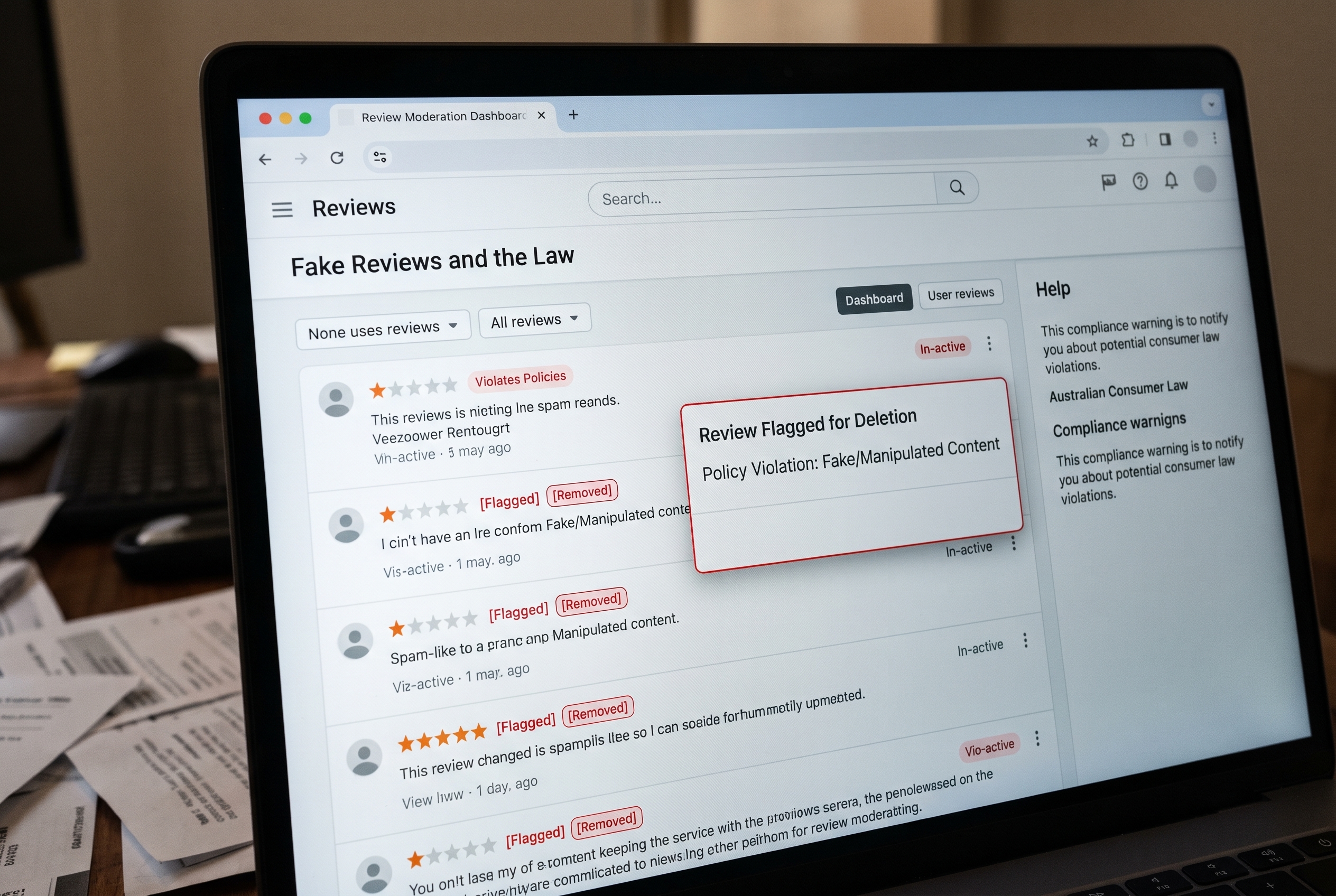
- Google blocked or removed over 292 million policy-violating reviews on Maps in 2025, up from 240 million in 2024 and 170 million in 2023. The figure comes from Google’s own 2025 trust and safety report.
- That is roughly one in five review attempts. Google published more than a billion reviews in 2025 alongside the 292 million it stopped, so around 22% of all review activity was classed as policy-violating.
- Google also removed more than 13 million fake Business Profiles, blocked 79 million inaccurate or unverified edits, and restricted posting from more than 782,000 accounts.
- In April 2026, Google banned asking staff to collect a set number of reviews, or asking for reviews that mention staff names. This catches a lot of well-meaning Australian businesses running review incentives for their team. The safe approach is one neutral request to every customer, after the job.
- Fake reviews carry real penalties in Australia. The Federal Court ordered Service Seeking to pay A$600,000 for publishing reviews drafted by businesses that went live automatically if the customer did not respond within three days.
- Meriton was penalised A$3 million for manipulating its TripAdvisor review process to keep negative feedback off the platform.
- The ACCC has also penalised businesses for influencer and testimonial content. PhotobookShop paid penalties over misleading influencer reviews, and the removalist Citymove paid A$30,600 for fabricated testimonials. Fake and misleading reviews breach the Australian Consumer Law.
One extra rule for health businesses. Dentists, physios, chiropractors and other regulated health services are covered by the Health Practitioner Regulation National Law, which restricts using testimonials in advertising. Reviews on Google are fine. Quoting them in your ads is not.
Google Business Profile Statistics
- Google says complete Business Profiles are 2.7 times more likely to be considered reputable, 70% more likely to attract a visit and 50% more likely to lead to a purchase. These are Google’s own marketing figures with no published sample or method, so read them as indicative rather than measured.
- Only 35% of small and medium businesses have a Google Business Profile at all, and only 40% have a dedicated website. For anyone who has sorted theirs out, that is a lot of competitors still standing still.
- Google removed GBP chat and call history on 31 July 2024. If your profile still promotes messaging, it has not worked since mid-2024.
Local Ranking Factors
- The latest expert survey of local ranking factors scored 187 factors across 47 specialists. Whitespark’s 2026 study found review signals, behavioural signals such as clicks, calls and direction requests, and website quality all rising in weight. For the first time it added AI search signals, and its framing was that local search and AI search signals have effectively merged. It is expert opinion rather than controlled testing, but it is the most comprehensive view available.
- Google Business Profile signals account for roughly 32% of local pack influence, and review signals about 20%, up from 16% in 2023, in the same survey series.
Put that alongside the near me data above. For the many local searches with near-zero organic difficulty, your profile, your reviews and your proximity decide who shows up.
Map Pack and AI Overviews in Local Search
This is the question most local business owners are actually asking: is AI going to take my leads?
The short answer, from the data, is that AI is taking the research searches and leaving the ready-to-book searches mostly alone. For now.
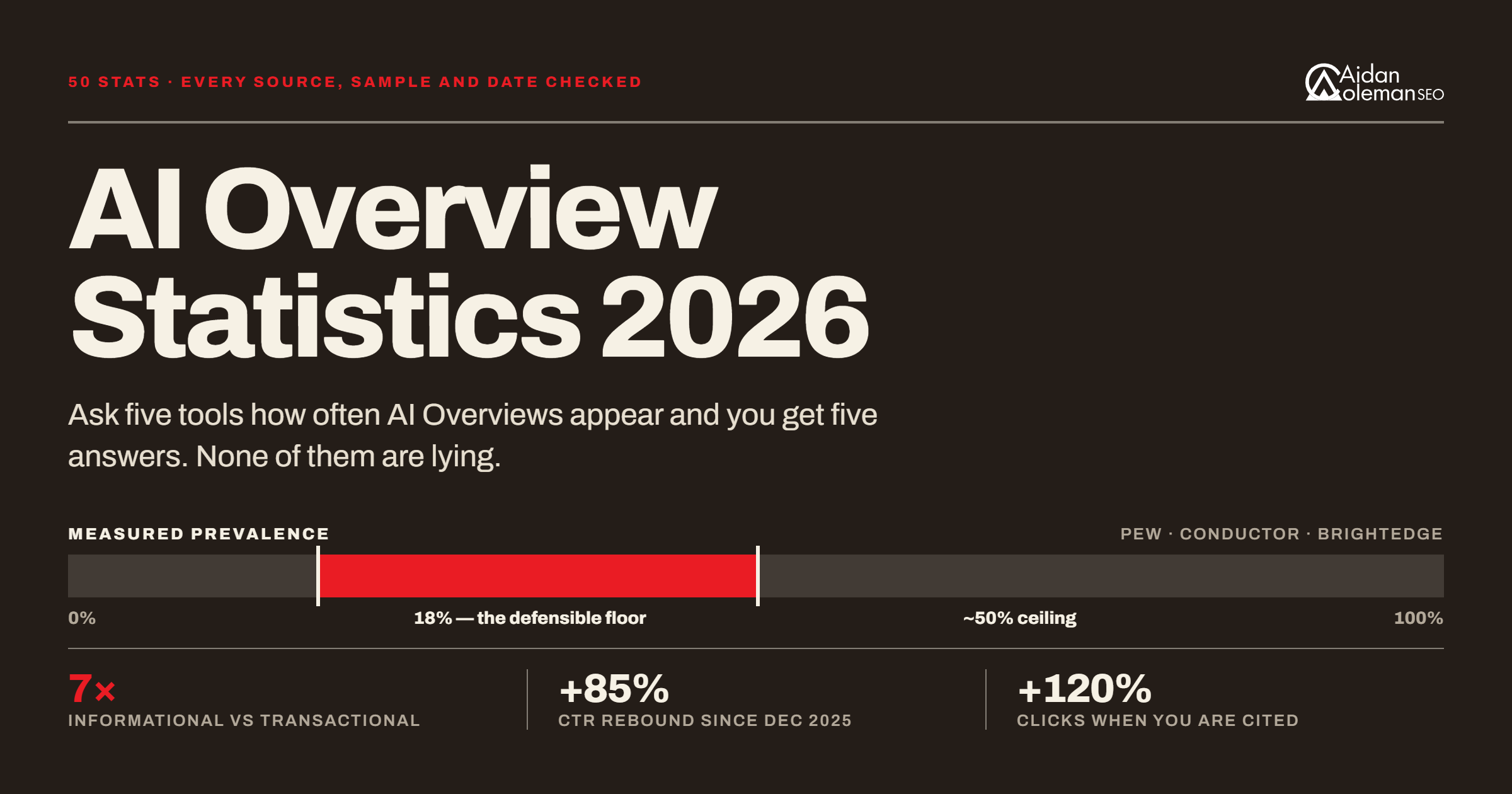
- AI Overviews appeared on around 68% of local business searches overall, while the local pack appeared on about 39%. Whitespark ran 540 manual searches across three cities and six high-intent service industries.
- But on genuinely local-intent searches, the local pack appeared 93% of the time and AI Overviews just 15%. When someone wants a business near them, Google still shows the map.
- On informational local searches, it flips completely: AI Overviews 92%, local pack 6%. Questions like “how much does a bathroom renovation cost” are now answered by AI before anyone sees a business.
- Informational “near me” searches showed an AI Overview 76.9% of the time, across a large 2026 dataset of 53 brands and 5.47 million queries.
- Transactional searches showed AI Overviews only around 5% of the time, and commercial searches around 8%. The searches where people are ready to hire are still largely AI-free.
- When an AI Overview does appear, the top organic result gets 58% fewer clicks, on a study of 300,000 keywords. That is up from 34.5% a year earlier.
- But being cited inside the AI Overview earns around 120% more clicks than not being cited. On informational local searches, being the source is worth fighting for.
The practical read for a tradie or a clinic: your service and booking pages are still competing in a Map Pack world. Your “how much does it cost” and “what’s the difference between” content is now competing with AI. Both need attention, but for different reasons.
Australian Local Search Statistics
Nearly every local SEO statistics article runs on US data. Here is what we know about Australia specifically.
- Google held nearly 94% of Australian general search as of August 2024, with Bing on just 4.7%, according to the ACCC’s Digital Platform Services Inquiry. Google Search was also the default on more than 91% of mobile browsers. More recent monthly figures put Google’s share at around 88 to 91% as Bing picks up ground through Copilot and Edge.
- There are 2,814,778 actively trading businesses in Australia, according to the ABS, as at June 2026. Around 97% are small businesses and roughly 65% have no employees at all. Health care and social assistance was the fastest-growing sector, up 6.7%.
- 97% of Australian adults access the internet on a mobile phone, and 92% use mobile internet every day, according to ACMA’s 2026 communications report. Local search in Australia is overwhelmingly a mobile activity.
- Google Local Services Ads are not available in Australia. Google’s eligibility list covers the US, Canada, the UK and several European countries, but not Australia. Several Australian agency pages claim otherwise. If someone is selling you “Google Guaranteed,” ask them to show you where it runs here.
- hipages had 36,400 subscribed tradies and facilitated 2.7 million business-household connections in FY26, with revenue up 9% to $90.6 million, according to its ASX results. For tradies, the platform remains one of the few Australian directories with audited usage data behind it.
Two other Australian points worth knowing, though they are dates rather than statistics. AI Overviews launched in Australia in October 2024 and AI Mode followed in October 2025, and Apple’s business listing platform is available here, now rebranded as Apple Business. Given that Apple Maps review usage has nearly doubled, claiming your Apple listing is one of the cheapest local wins available.
What This Means for an Australian Local Business
Check what your searches are actually worth. Plumber near me is worth 28 times cafe near me per click. The value of local SEO depends entirely on your category, and the index above gives you a starting point.
Your Google Business Profile is doing most of the work. For the many “near me” searches with near-zero difficulty, Google answers with the Map Pack. Profile completeness, reviews and proximity decide who shows up. Local SEO for most Australian service businesses starts and ends there.
Reviews need to be recent, not just numerous. 74% of consumers only value reviews from the last three months. A pile of reviews from 2022 is not doing much.
Respond to every review, and do not use a template. 89% expect a response. Templated replies put off half of them.
Stay on the right side of the rules. No review quotas for staff, no asking for staff names in reviews, no incentivised or drafted reviews. Google removed one in five review attempts in 2025, and the ACCC has shown it will pursue Australian businesses.
Claim your Apple listing. It takes an afternoon and most of your competitors have not done it.
Do not panic about AI yet, but do not ignore it. Ready-to-book local searches are still mostly AI-free. Your informational content is not. Being cited in AI answers matters more on those pages, and AI visibility is now worth tracking alongside rankings.
Methodology
The Australian “Near Me” Index was built from Ahrefs Keywords Explorer, Australian database, in September 2026. Thirty “near me” searches were selected across trades, health, professional services and hospitality. Search volumes are Ahrefs’ modelled estimates, not figures reported by Google. Cost per click was converted to Australian dollars at approximately 1.44. Monthly ad value is volume multiplied by cost per click, and is intended as a rough comparison of commercial value rather than a forecast of revenue. Keyword difficulty is Ahrefs’ 0 to 100 score based on the links pointing at the current top 10 results.
Third-party statistics are attributed to their original source with sample size and date, and linked to the primary source wherever a verified URL exists. US-based studies are identified as such and should be treated as directional for Australia. Statistics that could not be traced to a primary source are listed in the section above rather than repeated as fact.
If you cite or reproduce the Australian “Near Me” Index, please link back to this page.